The Integral Fast Reactor (IFR) project
"In the decade from 1984 to 1994, scientists at Argonne National Laboratory developed an advanced technology that promised safe nuclear power unlimited by fuel supplies, with a waste product sharply reduced both in radioactive lifetime and amount. The program, called the IFR, was cancelled suddenly in 1994, before the technology could be perfected in every detail. Its story is not widely known, nor are its implications widely appreciated. It is a story well worth telling, and this series of articles does precisely that."
--- excerpt from Plentiful Energy and the IFR story by Charles Till
"Other countries are developing nuclear power. They haven't said 'Well, the US has stopped it, we're going to stop it.' We are inevitably shifting what was a real technological lead overseas. And we will wind up then, sometime in the future, when we need to have that option, negotiating with some other country to bring it back."
--- Alan Schriesheim, Director, Argonne National Laboratory, 1984 to 1996"I think what is actually happening is that the United States is being swiftly passed by China. Within 20 years, I think China will be selling nuclear reactors all over the world, and supplying the operating staff for those reactors, and selling the fuel for those reactors. They will be a super-power in every way. Sadly, distracted by terrorism and the fossil fuel lobby (oil, gas, and coal), we are letting it happen, even though we have the innovative capacity and national productivity to leap-frog China. Representative democracy with special interest lobbying is not necessarily the most competitive institution. It seems possible to me that top-down decision making can sometimes make better decisions than an ignorant crowd manipulated by entrenched interests."
-- Chris Uhlik, Engineering Director, Google"The country which first develops a breeder reactor will have a great competitive advantage in atomic energy."
-- Enrico Fermi, Los Alamos, 1945"Our best hope today for meeting the Nation's growing demand for economical clean energy lies with the fast breeder reactor."
-- President Richard M. Nixon, 1971"Taking nuclear power off the table as a viable alternative will prevent the global community from achieving long-term gains in the control of carbon dioxide emissions."
-- The Future of Nuclear Power, MIT report, 2009
Why do we need the IFR now?
In order to re-start nuclear power, it is best if we have a solution that overcomes as many public objections as possible: safety, waste, cost, and proliferation. The IFR is a vast improvement in all of these areas.
Specifically, we should pursue the (U.S.-developed) IFR because
(a) it operates symbiotically very nicely at the back end of the thermal-reactor fuel cycle,
(b) it solves the "waste problem" by removing the need to isolate the waste for more than 300 years,
(c) it utilizes a very large fraction instead of a minuscule fraction of natural uranium (factor of more than 100),
(d) it permanently eliminates the need to enrich uranium,
(e) it permanently eliminates the need for land-based mining of
uranium: sea water becomes a perpetual and very economical source of uranium (but it won't be needed for centuries because of the uranium we have already accumulated).
(f) it leads eventually to the secure sequestration of virtually all of the world's plutonium, and
(g) if the U.S. does not resume the technological and geopolitical lead in this area, the global development of nuclear technology will continue to spread anarchistically, every nation for itself.
Key features of the IFR include:
- Inherently safe: it is safer than LWR reactors because it passively shuts itself down if something goes wrong: no computers or valves are involved. This was proven in tests where the coolant flow was shut off and the reactor shut itself down without operator intervention or the intervention of any active or passive safety devices. The basic design and safety performance was reviewed by the NRC. In January 1994, the NRC issued a pre-application safety evaluation report which concluded that no objections or impediments to licensing the IFR design have been identified.
- Produces no long-lived waste: It produces virtually zero long-lived nuclear waste. All of the long-lived waste is recycled in the reactor and used for fuel. Only the short-lived radioactive waste remains and that is only dangerous for a few hundred years and we know how to solve that problem.
- Uses existing nuclear waste for fuel: It uses existing waste (from bombs and nuclear reactors) as fuel so it solves the "what do we do with all that nuclear waste" problem. All of that waste is burned to produce energy. No long-lived waste remains.
- Fast nuclear is an inexhaustible energy resource: Unlike with LWRs, with fast reactors you will never run out of cheap fuel. Fast reactors are over 100 times more fuel efficient than today's light water reactors. Enough to power our planet for billions of years.
- Proliferation resistant: The IFR recycling process cannot separate out pure Plutonium so it does not create an easier path for a terrorist to make a bomb. It creates a path where it is almost impossible to make a bomb. If we choose not to promote this technology, the world will standardize on a much more dangerous recycling process where is it is much easier to make a bomb. By switching to fast reactors, we eliminate the need for enrichment which is the big proliferation risk today.
- Low cost: It is potentially less expensive than today's nuclear reactors (assuming you can get down the manufacturing cost curve) because most of the key pieces are built in factories and shipped to the site rather than built on-site.
- High reliability: Our own EBR-II ran for 30 years with incident before being shut down for political reasons in 1994. The Russian fast reactor (BN-600) which has been producing electricity commercially for more than 30 years has been among their most reliable reactors in their fleet. The Chinese recently ordered two fast reactors from the Russians.
- The NRC has pre-approved the design: In January 1994, the NRC issued a pre-application safety evaluation report which concluded that no objections or impediments to licensing the IFR design have been identified.
- Objective analysis confirms it is the world's best Gen IV reactor design: Although there are other reactor designs such as the LFTR that might appear to be promising, the IFR was rated #1 in a multi-year comparative study done by the Gen IV International Forum. It has the support of Hans Bethe, over 1,500 scientists from ANL, support from the scientists who have the most hands-on experience with fast reactors, support from former top nuclear management at DOE, and so on. GE has a commercial design that has been pre-certified; they are ready to submit to NRC certification and build. We have three decades of operational experience with it and most of the hard problems have been solved. If you only have money to build one fast reactor, this is clearly your best choice. Nothing else is even close.
- Support from the National Academy of Sciences: The National Resource Council committee sponsored by the National Academy of Sciences concluded that liquid metal fast reactors (such as the IFR) should have highest priority for long-term nuclear technology development..
- We've already committed to work with France and Japan on the development of prototype/demonstration Sodium Cooled Fast Reactors (which includes the IFR). We just signed a Joint Statement of Trilateral Cooperation on the IFR technology on October 4, 2010. The other countries will build it; the US will continue research for 30 years and build nothing, giving those other countries a 30 year head-start on technology we invented.
These are a few of the reasons why other countries (like Russia, France, Japan, China, and India) are constructing new fast reactors today.
The current US Department of Energy plan is to continue to dismantle our only remaining fast reactor and to study this technology for at least 30 years before deciding whether to build one again. This gives other countries at least a 30 year head start on us.
How do we become leaders in advanced nuclear by allowing other nations to have a 30 year head start? I don't know because nobody I've talked to has a straight answer to that question.
Why is nuclear energy attractive?
-
 Nuclear is the cleanest source of energy with smallest
environmental disruption. If affects the least amount of land while
generating tiny quantities of waste which are tightly controlled.
Nuclear is the cleanest source of energy with smallest
environmental disruption. If affects the least amount of land while
generating tiny quantities of waste which are tightly controlled. -
Nuclear is the safest source of energy killing the fewest people per GW-hr of any source in history.
-
Nuclear is among the cheapest sources of energy with large plants like Palo Verde in Arizona being hugely profitable.
-
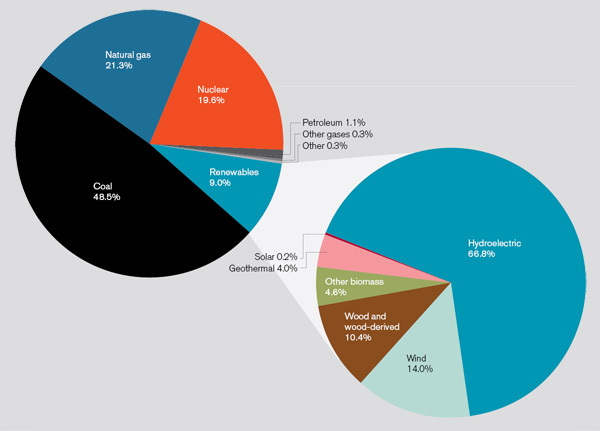
Nuclear can be quickly scaled to meet the clean energy needs of the entire nation; renewables cannot: Most of our 100 nuclear plants were all started within a 3 year window. Today, nuclear supplies 70% of our clean power. We haven't built a new nuclear plant in 30 years, but renewables are still rounding error in terms of contribution to our power. Hydro (which is not scalable) is 66% of the renewable contribution. Even with a 30 year head start, nuclear today supplies 15 times more power than wind and solar combined!
-
Nuclear power works reliably 24x7: it is independent of the weather and the time of day. Capacity factors are near 100%.
-
With fast nuclear, we don't need any more uranium mining and we can use existing waste as fuel so environmental damage is minimized
A nuclear power plant design invented at Argonne National Lab 24 years ago has none of the drawbacks of conventional nuclear plants
 To control climate
change, we must get rid of virtually all carbon emissions from coal. To do that, we need a way to generate
power for a cost less than coal, that can generate power reliably 24x7, and that can be constructed
virtually anywhere. Solar and wind don't meet the need; that is why even
environmentally progressive countries such as Germany are still building
coal plants. But we have a technology that can displace coal, but it is not
well known. It was a billion dollar government research project...over
10 years at our top government national laboratory for energy (Argonne
National Laboratory)...the
largest energy research project in our history. Our government had finally done
something truly visionary and great! But the project was quashed by
President Clinton in 1994 because Clinton said it was unneeded and the scientists who worked on it were ordered to
remain silent. One of our
country's leading experts on global warming, Jim Hansen, recently
re-discovered the IFR. Those who have been briefed on
the IFR believe it is an essential technology we must develop to combat climate change and should be restarted immediately.
This led to Hansen including restarting 4th generation nuclear power as one
of his 5 top priorities for President Obama (see the bottom of page 7 in
Hansen's Tell Barack Obama the Truth -- The Whole Truth).
To control climate
change, we must get rid of virtually all carbon emissions from coal. To do that, we need a way to generate
power for a cost less than coal, that can generate power reliably 24x7, and that can be constructed
virtually anywhere. Solar and wind don't meet the need; that is why even
environmentally progressive countries such as Germany are still building
coal plants. But we have a technology that can displace coal, but it is not
well known. It was a billion dollar government research project...over
10 years at our top government national laboratory for energy (Argonne
National Laboratory)...the
largest energy research project in our history. Our government had finally done
something truly visionary and great! But the project was quashed by
President Clinton in 1994 because Clinton said it was unneeded and the scientists who worked on it were ordered to
remain silent. One of our
country's leading experts on global warming, Jim Hansen, recently
re-discovered the IFR. Those who have been briefed on
the IFR believe it is an essential technology we must develop to combat climate change and should be restarted immediately.
This led to Hansen including restarting 4th generation nuclear power as one
of his 5 top priorities for President Obama (see the bottom of page 7 in
Hansen's Tell Barack Obama the Truth -- The Whole Truth).
The DOE tried to restart it under GNEP, but Congress has zeroed the funding for GNEP (not for reasons relating to the IFR which nobody in Congress knows anything about). Talk about snatching defeat from the jaws of victory.
California Lt. Governor John Garamendi flew in the top IFR scientists and convened a meeting of experts in the field including one Nobel prize winner (Burton Richter, former Director of SLAC). Garamendi came away impressed and convinced that this is something we must do and is working to take the next steps in California.
by Steve Kirsch
August 10, 2008
Until now, I have been pretty agnostic about nuclear power. In fact, in May 2006, I wrote an op-ed for the San Jose Mercury News on why we shouldn't pursue nuclear power as a solution for global warming which infuriated the pro-nuclear people.
 After reading Hansen's newsletter (where I first learned about the IFR) and
doing months of research on the IFR listening to arguments on both sides, I've
changed my opinion. And some really smart friends
of mine have read the stuff below, done their research, and their minds have changed as well.
In fact, I don't know anyone with an open mind who has met with the scientists who worked on the
project who hasn't come away impressed. Even the harshest critics of the IFR
admit that that they might be wrong.
After reading Hansen's newsletter (where I first learned about the IFR) and
doing months of research on the IFR listening to arguments on both sides, I've
changed my opinion. And some really smart friends
of mine have read the stuff below, done their research, and their minds have changed as well.
In fact, I don't know anyone with an open mind who has met with the scientists who worked on the
project who hasn't come away impressed. Even the harshest critics of the IFR
admit that that they might be wrong.
I first heard about the IFR on August 4, 2008, in an email I received from James Hansen who is one of our nation's top climate experts. The email summarized his recent trip overseas to meet with foreign leaders.
The two most important things that Hansen tells foreign heads of state are (from page 5):
- Annual CO2 emissions, and thus percent reduction of annual emissions, is not an appropriate metric for controlling climate change. Instead, we must limit the total fossil fuel CO2 emission.
- Phase-out of coal emissions is the sine qua non for climate stabilization.
In other words, if we don't get rid of coal plants all over the planet, we're completely hosed. The sooner we do that, the better. Getting rid of every single coal plant is the single most important thing we can do to slow down global warming. If we cannot do that, then nothing else matters. We are basically re-arranging deck chairs on the Titanic. We will go down with the ship.
Displacing coal plants is hard because they are really cheap (since the utilities are not assessed of their pollution), they can be built anywhere where water is available (all thermal power plants, fossil or nuclear, have to be able to get rid of excess heat), and because they provide power 24x7. That's why every week to 10 days, another coal-fired power plant opens somewhere in China that is big enough to serve all the households in Dallas or San Diego.
Getting rid of them is hard. Even with all the awareness about the harm of coal plants to the environment in the US, we have been unsuccessful in displacing them. Today, we still get 49% of our electric power from coal plants. If we can't displace coal plants in the US, how can we expect other countries, like China, to displace their coal plants?
Fundamentally, to get rid of coal plants and have any hope at all on controlling climate change, you must to come up with a power plant capable of 24x7 operation that can be built anywhere that is just as cheap (or cheaper) to build and operate as a coal plant. If you had that, then you'd have an economic incentive for people to make the environmentally responsible choice. There would be no reason to build coal plants anymore.
So if the US developed a way to generate electric power that had no CO2 emissions, was as cheap as coal, and provided 24x7 power, and could be built anywhere, and didn't require a lot of land to build, and was very safe, and didn't increase the risk from terrorism then that would be a great thing. It would mean that China would have an economic incentive to build these plants rather than coal plants.
We don't have that now. Concentrated solar plants can only be economically built in certain locations. Same for wind power. And both are intermittent sources (although if you have enough wind power over enough area in the right corridor, it can be pretty reliable).
Such an invention would, quite literally, save the planet from destruction. It would be the "holy grail" in the fight against global warming. It would arguably be the most important invention in history.
So you'd think that if such an invention existed, everyone would know about it, wouldn't you?
Well, would you believe that our top energy scientists invented a technology that does all those things and more! These plants can also get rid of the waste from existing nuclear power plants! And unlike nuclear plants where there is only a finite amount of nuclear material available (I think about 100 years), these plants make their own fuel so they will last 100,000 years. Remember Einstein's famous E=mc2? The point is that if you do it right, a little bit of matter can make a lot of energy.
And would you believe the research was done more than 20 years ago in 1984 by a large group of US scientists at Argonne National Laboratory?
The Integral Fast Reactor (IFR) is a fourth generation nuclear design that provides a clean, inexhaustible source of power, cheap, with virtually no waste, inherently safe (if you remove the cooling, it shuts down rather than melts down), and the added benefit that it consumes the nuclear waste from other nuclear plants that we can’t figure out how to get rid of.
Advantages include:
- It can be fueled entirely with material recovered from today's used nuclear fuel.
- It consumes virtually all the long-lived radioactive isotopes that worry people who are concerned about the "nuclear waste problem," reducing the needed isolation time to less than 500 years.
- It could provide all the energy needed for centuries (perhaps as many as 50,000 years), feeding only on the uranium that has already been mined
- It uses uranium resources with 100 to 300 times the efficiency of today's reactors.
- It does not require enrichment of uranium.
- It has less proliferation potential than the reprocessing method now used in several countries.
- It's 24x7 baseline power
- It can be built anywhere there is water
- The power is very inexpensive (some estimates are as low as 2 cents/kWh to produce)
- Safe from melt down because if something goes wrong, the reactor naturally shuts down rather than blows up
- And, of course, it emits no greenhouse gases.
What's wrong with that? Absolutely nothing...that is if you look at the facts and the science rather than the words.
Sadly, most people when they hear "nuclear reactor" or "breeder reactor" react negatively. "Not in my backyard," they say. But that's because of second generation nuclear technology. When people say "no nuclear," they really are referring to "second generation nuclear." Everything about the IFR and fourth generation technology is completely different. The words with negative connotations are no longer negative. Yet we have this bad habit of remembering the bad associations. We have to overcome that. For example, one scientist told me, "Breeding, however, is a dirty word these days, so the GNEP emphasis is on burning the transuranics, instead of using them to assure an expanding source of clean energy into the indefinite future." So, in other words, we are doing stupid things because "breeding" is a dirty word. "Breeding" for the IFR is the nuclear equivalent of "recycling and re-using." That's a good thing, not a bad thing. And the safe word, "burning," is actually a bad thing. So the connotations are actually reversed.
We actually gave a group of our smartest scientists funding for 10 years and left them alone to come up with something brilliant so that it could be completed before we actually needed to deploy it. Talk about visionary, long-term thinking! Of course today things are different. Today, Congress is completely shortsighted. After gas is at $4/gallon, they say we need to drill for more oil. Well if that is the solution, how come we didn't do that 10 years ago so we wouldn't have a crisis?
So here, in a rare instance of long term strategic investment and vision, our government did something really amazing in funding this project. And the scientists returned that trust by delivering on their promises. And then our government thanks them by pulling the plug on the project just before it was completed.
When Bill Clinton cancelled the funding in 1994, he said in his State of the Union speech that he did it because the project was unnecessary, not because it didn't meet any of its objectives. In his speech, he said, "We will terminate unnecessary programs in advanced reactor development."
He never asked the National Academy of Sciences to look into whether this project was unnecessary. Why not? Shouldn't you do a little objective research before you pull the plug on the biggest energy research project in history?
The Integral Fast Reactor (IFR) technology is arguably the single most important thing we can do to stop global warming. If it isn't the single most important thing, it's awfully close to the top.So if this is so great, how come everyone isn't all over this technology?
Because nobody knew about it!
How can that be?
Because the DOE ordered the scientists working on the project not to talk about it.
Why would the government do that?
Why do you think the government would pour billions of dollars into the biggest energy research project in history and then not just cancel it, but do their best to bury it? The researchers at Argonne developed a safe and economical source of unlimited clean energy. Between that and the other renewable power technologies we wouldn't need oil, coal, gas or uranium mining/drilling anymore. We're talking about putting the most powerful corporations on the planet out of business. Not out of malice or spite, but simply because they won't be needed anymore and because what they're doing to the planet is killing us.
Some people think that the fossil fuel lobbyists could tell you why our government ordered the scientists not to talk about it. It's similar to the gag order (and edits to manuscripts and reports including IPCC reports) that the administration likes to put on scientists who try to talk about global warming. Jim Hansen can tell you a few stories about that since he's experienced it first hand.
In fact, Hansen himself just found out about the IFR recently. Hansen is very informed. So if he didn't know about it, it's probably not well known. And that's what I found when I asked around.
According to this article that just appeared in the Seattle Post-Intelligencer, Bill Gates is investing in a project at Intellectual Ventures to "create a new type of nuclear reactor that would use fuels other than enriched uranium -- including spent fuel from existing reactors." The article quoted Myhrvold as saying " The idea is to create a nuclear reactor that is simpler and cheaper than current reactors, and generates clean power without waste or proliferation problems."
Well that's exactly what the IFR did. They knew about the IFR. It would be great if he could help it succeed or has ideas on how to make it even better.
GE has created a commercial plant design called the S-PRISM. GE is ready and willing to build a plant (a) to demonstrate the technical feasibility of a commercial-scale operation, and (b) to narrow the existing uncertainty in the final cost. They are not proposing, yet, to plunge into mass production of S-PRISMs. We can start building a reactor vessel for around $50 million.
Apparently, Al Gore doesn't know about the IFR either. Check out this video where Senator Craig (a strong advocate of the IFR in 1994 but not really known for his advocacy of good science) chastises Gore for his role in cancelling advanced nuclear research in 1994. Gore doesn't know what Craig was talking about. More recently, people associated with the IFR tried to brief Gore, but they couldn't get past Gore's defensive linemen.
Cancelling the IFR was a huge mistake...One US Senator even commented how Congress will regret that decision. He said,
I couldn't have said that better. And Senator Kempthorne, who also isn't exactly known for his advocacy of science, is still waiting for his colleagues in Congress to regret and reverse their decision."I assure my colleagues someday our Nation will regret and reverse this shortsighted decision. But complete or not, the concept and the work done to prove it remain genius and a great contribution to the world."
"Through his work on the Integral Fast Reactor program, Dr. Till demonstrated that his technical solutions out paced the ability of the political process to appreciate them."
The good news is that DOE is trying to restart IFR with the GNEP (Global Nuclear Energy Partnership) initiative. The GNEP, if it is allowed to proceed, will involve a commercial demonstration that will establish the degree of economic competitiveness of the recycling process. General Electric thinks they can build an economically viable system and they already have a complete commercial design completed (S-PRISM).
But it looks as though Congress, in a classic case of throwing the baby out with the bath water, might decide to zero the funding of GNEP due to other aspects of the GNEP program.
Once again Congress shows how easily they seem to snatch defeat from the jaws of victory. The same Congress that brought you the Iraq war is now making sure that the best solution to the global warming never sees the light of day.
Hansen was blunt in his most recent trip report when he wrote “we should not have bailed out of research on fast reactors.” Yet here we are doing it again. When are our politicians going to start listening to our scientists who are trying to solve the global warming problem?
Are there any other promising technologies that have no emissions and the potential to displace coal plants and can be sited anywhere? I don't know of any other than this.
But we should be looking at the ideas that are on the table now and funding the most promising 5 ideas with stable long-term funding (e.g., 10 years or more) that isn't subject to the capriciousness of Congress. That way, we'll have solutions available when we desperately need them instead of the normal short sighted approach we take which is to react to a crisis rather than take preventative steps. An energy crisis should never have occurred in the US. We should have been making huge investments in renewable research 10 to 20 years ago.
In this case we got lucky and did make the investment in electric power generation and the technology is available today when we need it. What a miracle.
Now we need another miracle: we need our government to restart the research at Argonne, we need the NRC to accelerate the approval of the plant designs, and we need to allow utilities to start building these plants. GE is ready and willing to build a demonstration plant.
California has a ban on new nuclear plants until the waste problem is solved. But building the IFR solves the waste problem. So I hope California will be a leader in incentivizing our utilities to start building these plants here. If California needs to change the law to do that, it should.
For around $50M, we can build a reactor vessel to expedite certification and licensing by the NRC. That's a small price to pay to prove we have a silver bullet to solve the global warming problem. This is too good an opportunity to pass up.
I am not suggesting that the IFR is the be-all, end-all solution to the global warming problem. Some people believe other technologies (e.g., high-altitude wind, such as MakaniPower.com, solar thermal such as Ausra, the work MIT is doing on solar electrolysis and fuel cells, or enhanced geothermal (EGS)) might be a silver bullet. Maybe. Maybe not. Most experts think you need a mix of good solutions just like we have a mix of ways to generate power today.
From a risk management point of view, you certainly want to cultivate and develop at least a small portfolio of silver bullets, i.e., "silver buckshot." After spending a lot of time talking to the people who built this technology, it's clear to me that the IFR deserves a place in that portfolio. The research at Argonne should be restarted now and someone should ask GE to build one; either a big utility or Congress should give DOE the money so they can have GE build a pilot S-PRISM test plant.
We are running out of time. If we do not start using breeder reactors, such as the IFR, this century, then it appears we will reach "peak nuclear" this century. If we use 4th generation breeder reactors such as the IFR (whose only disadvantage seems to be perception), we can extend the usable life of our nuclear resources to 1,000 years or more (see GamePlan, p. 126) with the IFR folks estimating over 50,000 years.
Also, it's not something we can decide to do later. If our objective is to get to 20% nuclear in our energy mix, that means we must build one 3GW plant per week for the next 25 years (see GamePlan, p. 149)!
So unless we are absolutely 100% sure we don't need nuclear, we should start very soon, or that option will be lost forever.
Mary Nichols, chair of California's Air Resources Board has been convinced for years, and has said publicly, that nuclear would be needed and would make a comeback but only with breeder technology. While she has not yet been briefed in the IFR, she wants to learn more about it and a meeting has been set up.
A number of people who have read the above had additional insightful questions, such as "how do you respond to the disadvantages listed on the wikipedia page on the IFR?" or "if this is so good, why doesn't GE have a customer for the S-PRISM?" or "how do you address the proliferation problem?" Those questions, and more, are answered here: The Integral Fast Reactor (IFR) project: Q&A.
Here are some more interesting facts:
- Nuclear provides 70% of the carbon free electric power in the US even though we haven't started building a new nuclear plant in 30 years!
- With the used fuel plus depleted uranium that's on hand, we can power the world for centuries before having to mine new uranium. With fast reactors and eventual mining, uranium is inexhaustible
- There's much more energy in the depleted uranium on hand than there is in the coal still in the ground.
- Your typical coal plant emits well over 100 times more radioactive materials than a nuclear plant! See p. 89 of Blees' book for figures that will astound you.
- Some 24,000 people die prematurely in the US from the effects of soot from coal plants (see p. 99). Annual health care costs due to soot, per year: $167 billion dollars (see p. 100)!
- Even if you add the 56 deaths from Chernobyl, far more people have been injured or killed from hydropower, oil, and gas (see p.99 of Blees' book).
- With the investment of (nuclear) energy, carbon can be extracted from
CO2 and hydrogen from water, to make synthetic liquid fuel. No coal involved
-- unless the CO2 comes from existing coal-fired plants. Simplest, perhaps,
is to make methanol (CH3OH): 2CO2 + 4H2O + energy -> 2CH3OH + 3O2. It
is truly carbon-neutral, since the CO2 emitted when the fuel is burned is
only equal to what was used in the first place. This would make use of the
existing distribution infrastructure while a better system (batteries or
boron, perhaps) evolves. While this has been known for several years, very
few people seem to know about it. See
http://www.AmericanEnergyIndependence.com/nuclearenergy.aspx. Also, the Carbon Dioxide web page provides detail about recycling CO2: http://www.americanenergyindependence.com/co2.aspx. See the section titled: CO2 is valuable, don't waste it, recycle it! So this would solve our problem of how to eliminate CO2 for transportation with complete compatibility with our existing infrastructure. Experts think it would take 15 to 20 years of work before this is viable, however. Here are two excellent videos: http://uk.youtube.com/watch?v=_ST7oCLUCw4
- We read about coal plant discharges all the time. The last time we heard
about a nuclear discharge in the US was TMI. For example,
- On December 22, one billion gallons of coal ash sludge and contaminated water, the waste product of coal-fired power plants of the Tennessee Valley Authority, broke through a containment area into the rivers of Kingston, Tennessee.
- Last week a coal train operated by National Coal Corporation over turned spilling approximately 1100 tons of coal next to the New River in Scott County, Tennessee. Eight rail cars, which typically hold 120 tons of coal, were involved.
- And now another spill occurred in Alabama at the Tennessee Valley Authority Widows Creek coal-fired plant, releasing up to 10,000 gallons of polluted sludge.
- Nuclear operates without government subsidies
- Toshiba is building a micro reactor that is 100 times smaller than a typical nuclear plant, at 6 feet by 20 feet. It produces 200 kilowatts of energy at about 5 cents per kilowatt hour — cheaper than coal-fired power in most places in the U.S. The Japanese company will begin marketing the reactors in the United States and Europe in 2009.
- VCs are starting to invest in nuclear companies (see VCs have a nuclear reaction Technology, energy prices fire interest in new-era nukes).
There is a LOT of misinformation that is unfortunately being spread by seemingly credible sources. For example, here are some items to consider in response to an article that recently appeared in Scientific American:
-- The plutonium at WIPP is only "deadly" after a few thousand years if you go down there and live in close contact with it with it -- and maybe not even then.
The problems with fast reactors have been non-fundamental. Examples:
-- The Monju reactor was undamaged by the fire, and has been kept shut down for political reasons. I think it has been given the go-ahead to start up.
-- The EBR-II fast reactor worked flawlessly for many years.
-- The Phenix fast reactor in France has been on-line for decades.
-- The Superphenix reactor was shut down for political reasons, after it finally had its problems behind it and was working well.
-- The Russian BN-600 has been working well for decades
-- As you well know, the IFR technology has not yet been implemented. so Lyman's claim that "it never worked" is nonsense.
-- The fast-reactor waste would consist of 1 ton of fission products per GWe-year. True, "thousands of tons" if there were thousands of reactors. Easily dealt with -- harmless in less than 500 years (unlike coal waste).
And this comment from one of my blogs:
As Mr. Kirsch pointed out, statements that nuclear is in any way dirty or dangerous are utterly Orwellian. Completely at odds with known fact.
Here are some references (links) to clear up some other misconceptions repeated by Ms. Corbett:
Nuclear’s total overall net CO2 emissions are very small, ~2% of coal’s, ~5% of natural gas, and similar to (or lower than) renewables:
http://www.iaea.org/Publications/Magazines/Bulletin/Bull422/article4.pdf
Nuclear’s overall energy inputs are very small, less than 1% if the electricity output over 40 years (let alone 60, or 100):
http://nuclearinfo.net/Nuclearpower/WebHomeEnergyLifecycleOfNuclear_Power
Also, many analyses show that renewable sources like wind and solar require over 10 times as much steel and concrete, per kW-hr generated, than nuclear does. Their oil/gas inputs are probably greater as well.
http://nextbigfuture.com/2008/07/per-peterson-information-on-steel-and.html
In terms of both CO2 emissions, and oil inputs, however, the real point is that these issues are essentially negligible, for both nuclear and renewables, compared to using fossil fuels themselves.
Even Arjun Makhijani, who claims you can do it with just renewables, admits that today's technologies are not sufficient to solve our carbon-free energy needs!
The vast majority of renewable experts concede that nuclear must be part of the energy mix going forward. But there are still some environmentalists who claim you can do it without nuclear. Arjun Makhijani is one of the most prominent of these environmentalists having written a book "Carbon-Free and Nuclear-Free: A Roadmap for U.S. Energy Policy" about it.
But Arjun Makhijani and Nuclear Absolutism points out that at the 2008 debate with Patrick Moore, Makhijani acknowledged that removing fossil fuels and nuclear energy from the mix of energy generators would introduce baseload generation issues, but touted the human imagination as a source for solutions.
So sure, you can do it without nuclear, as long as you rely on us inventing a suitable replacement in time to save the planet. That seems risky to me when you have a perfectly good alternative that you know how to do.
Patrick Moore makes a great case. See Patrick Moore and Arjun Makhijani debate the future of Nuclear Energy for the debate.
Comments on the IFR from one of Australia's top climatologists
It's not just noted climatologist Jim Hansen and noted British environmental author Mark Lynas who think that IFRs are critical to solving the climate crisis. Below are some comments I received from Barry Brook, of Australia's top climatologists.
Brook read Blees' book and wrote this review of Prescription for the Planet on his website:
This list of posts also include what will eventually be a 6-part review series of the book by Tom Blees, Prescription for the Planet, which, within its 400 pages, describes IFR and some related technologies (boron-powered vehicles and plasma burners for waste recycling) that together circumscribe the most practical and innovate energy and sustainability solution I have yet encountered. It also looks carefully at how to achieve the energy revolution required on an international scale. It is, in my opinion, the most important book ever written on energy and climate solutions.
That prompted Friends of the Earth Australia to write a critique of the IFR. Here is Brook's (and other's) response to the FOE critique of the IFR. Note that while Brook has several links to the FoE critique so that readers can see both sides of the issue, FoE doesn't reciprocate. FoE provides no links whatsoever to Brook's site. So much for FoE promoting an open, balanced discussion.
The other thing the critics lack is a viable alternative, but they really never focus on this. They'll talk about terrorism or proliferation risks or all the reasons why the IFR isn't a perfect solution. That's not the point. The point about climate change is we have to displace coal at a minimum. If not the IFR, then what? The critics never talk about that.
I wrote to Brook:
this is so infuriating since IFRs are FAR FAR better than existing nuclear plants and existing nuclear plants have an INCREDIBLE safety record....far safer than any other power source. Obama's new Secretary of Energy Steve Chu points out that existing nuke plants produce 70% of the GHG-free power in America....it is even more amazing when you consider the fact that we haven't started building a new nuclear plant for 30 years!
He wrote back (emphasis mine):
It is infuriating, I agree, because environmental groups seem to be willing to sacrifice great opportunities to fix fundamental problems, completely, because of historical (and even then, mostly ill founded) biases, ideologies and misinformation. My primary goal is about fixing the climate change problem. I was utterly depressed when I worked through the numbers on renewables and found they didn’t stack up. But did I push that aside and pretend it was the solution anyway? No way! I got angry and felt without hope (until I found out about IFR). But I didn’t lie to myself or others in the interim (I just implied there was little hope, when pushed…). That form of disingenuous debating is what must be stamped out here, and that is why rebuttals of ‘propaganda’ pieces like that from FoE (the most strident anties in Australia who helped kill discussion on the Gen III issue here a few years back) MUST be pursued.
Even Gen III+ like the ESBWR are incredibly safe. IFRs just do it even better (good old physical laws). Anyway, I’ll get off my podium now.
Then I wrote:
In the FOE piece, they wrote:Also ignoring the fact that 70-80+% of greenhouse emissions arise from sectors other than electricity generation - so Kirsch's claim that IFR's could be the "holy grail in the fight against global warming" is stupid.but coal alone is responsible for 20% of global GHG emissions! See http://www.pewclimate.org/global-warming-basics/coalfacts.cfmMore importantly, that pew page also says: 68 percent of India’s CO2 emissions are from coalYikes. The point is that if you can't get rid of coal, we're screwed.
To which he replied:
What he wrote is at best grossly disingenuous. You need to solve the electricity carbon problem to fix the vehicular fuels problem, space heating and embedded energy in building and manufactured goods, and Tom has a solution for MSW [municipal solid waste] also. About half of agricultural emissions can also be solved if you have a zero-carbon energy source. Then you just need to worry about the ruminant methane and carbon from deforestation. But the bottom line is, if you fix electricity, every else will fall into place.
As you said in an earlier doc, Steve, if we don’t stop coal in places like China and India, we’re hosed, irrespective of what we might do in the US and Oz (and even if we could do with without advanced nuclear, which quite clearly we can’t: http://bravenewclimate.com/2008/12/21/renewable-energy-cannot-sustain-an-energy-intensive-society/ ).
If you want more on why renewables cannot do the job, read over the comments section in these two posts:
http://bravenewclimate.com/2009/01/16/put-all-energy-cards-on-the-table-to-fix-climate-change-fully/
I also pointed out to him that when I ask the IFR critics in the US for their plan for how they propose to stop China and India from using coal, they don't have an answer and admit nuclear is the way to go. He asked the same question of the critics in Australia. Here's what he wrote:
I had a similar set of arguments with an anti-nuclear campaigner for the Australian Conservation Foundation recently – he started hammering me about proliferation risks, and so I asked him what his plan was for replacing the 484 GW of coal-fired power stations already installed in China, and the further 200 or so plants in the planning or construction pipeline. Like your critic, he had no answer.
Similarly a strong collection of climate action groups recently protested at the Australian Parliament House and came up with a manifesto on actions required to produce a zero-carbon Australia. But one of their ‘non negotiables’ was a ban on all nuclear power. So I pointed out to them that they’re obviously not 100% committed to solving the climate problem fully after all [this was their ambit claim] – at least if it conflicts with other entrenched ideologies [as an alternative example, I’m not a vegetarian, but for scientific reasons I will no longer choose to eat beef or sheep if I have the option because of the climate-forcing effect of ruminant methane]. No answer.
There is a critique of IFR here: I plan to post a response on my blog, since the author Jim Green linked to it from a comment. Let me know if you have anything specific to say in response to it and I’ll add it to the rejoinder I’m about to write [with acknowledgement).
Anyway, please do keep me in the loop – I’ve vitally interested in pushing this forward and am getting traction. My full list of articles on IFR is here:
http://bravenewclimate.com/integral-fast-reactor-ifr-nuclear-power/
Comments on Mark Lynas's website in debate between Greenpeace and Blees
Mark Lynas read Blees book, checked out the facts, and found out conventional "wisdom" about advanced nuclear was wrong. So he came out in favor of the IFR. He was quickly denounced by his peers (see Mark Lynas: the green heretic persecuted for his nuclear conversion). He offered Greenpeace a chance to respond on the Mark Lynas blog, and also published Blees' rebuttal to the Greenpeace comments. Here are some of the reader comments from Blees' rebuttal (since at that point readers could evaluate both sides):
Regardless of what Greenpeace states on environmental grounds, they are not independent and not objective. They have no reason to want nuclear power in any form even if they want to resolve AGW issues.
Thank you Tom for your article and also to Mark for posting it for us. A clear, concise and informative article which for me would seem to illustrate sensibly that nuclear power is not only viable in every way but also relatively safe. Additionally of course as Tom says we should explore and invest in renewables. What a great position it would be to not need nuclear power in the future, although like many I think we will need it. I will leave those better qualified to argue the science here but Tom’s points are well made. I await Greenpeace’s response again with baited breath!
An eloquent and in-depth rebuttal, Mr. Blees. If only all solutions were as rock solid as this one…
Thank you Tom for you rebuttal. Nuclear is here for the foreseeable future and in some places growing. There are also no guarantees that renewables can replace fossil fuels within the uncertain timeframe, even with the desired demand side reduction. On this basis alone I’m convinced that it would be logical to invest in testing S-PRISM. It sounds a little too good to be true and may well be just another pipe dream. But again that’s an argument for getting the testing done.
We seemed to be stuck in old school debate as usual; Mark Lynas and/or Tom Blees presents an optimistic picture, while Greenpeace presents the negative one. It kind of makes it difficult to take either side seriously. Most of us readers aren’t educated enough to know which bit we should be throwing our pinch of salt on.
In the meantime, nuclear is becoming smaller and more affordable
Mini nuclear plants to power 20,000 homes
Toshiba Builds 100x Smaller Micro Nuclear Reactor
Summary of IFR benefits
- energy security
- global stability
- environmental quality
- anthropogenic global warming
- nuclear waste
You can justify the investment on just the waste problem alone, but the IFR is far more important. Calculations from a number of respected sources indicates that renewables are insufficient to solve our energy problems. That leaves nuclear. Even NRDC admits that. But the best nuclear by far is the IFR because existing nuclear is not sustainable (we'll run out of fuel unless we use breeder reactors like the IFR) and has higher costs and risks than IFRs. The IFR is simply a better nuclear design that is currently our best option as we move forward.
References on why renewables are insufficient to solve the climate crisis
Energy Secretary Chu, the President of MIT, and the renewable experts at the most recent Aspen Institute Energy Forum all agree that it is not responsible to believe that you can solve the climate crisis without nuclear. Here are a few more references.
http://bravenewclimate.com/2008/12/21/renewable-energy-cannot-sustain-an-energy-intensive-society/ http://bravenewclimate.com/2009/03/18/the-solar-fraud/ http://bravenewclimate.com/2009/01/16/put-all-energy-cards-on-the-table-to-fix-climate-change-fully/ http://bravenewclimate.com/2009/04/11/climbing-mount-improbable/ http://bravenewclimate.com/2009/02/12/integral-fast-reactors-for-the-masses/Australia: http://www.theaustralian.news.com.au/story/0,25197,25817955-601,00.html. MINING giant Rio Tinto has urged Kevin Rudd to immediately begin work on a regulatory regime allowing use of nuclear energy in Australia, arguing the viability of energy alternatives has been dramatically overstated. The company has advised the government to consider "every option" for power generation because its pledges on reducing carbon emissions and using renewable energy will expose industry and consumers to huge increases in their power bills. And it says that overly optimistic assumptions on the viability of alternatives such as wind and geothermal power, as well as so-called clean coal technologies, have created a "false optimism" which the government must challenge by commissioning new research. Some regions of Australia will not be located near good renewable energy resources or sufficient geological storage formations for CCS," the submission says. In these circumstances nuclear energy may provide the optimum clear, reliable and affordable energy option."
UK: http://www.withouthotair.com is particular good. David MacKay examines five plans for the UK to move a pure renewable society. The conclusion is that renewables are not sufficient: "Any plan that doesn’t make heavy use of nuclear power or “clean coal” has to make up the energy balance using renewable power bought in from other countries."
Japan: In particular, here's a description of Japan's quandry with respect to renewables: http://bravenewclimate.com/2009/07/19/we-need-a-real-global-plan-for-carbon-mitigation/. Here's a statement from Japan's Federation of Electric Power (FEPC) companies on why renewables, while desirable, are not sufficient: http://www.japannuclear.com/nuclearpower/program/why.html says: Alternative energy sources such as solar and wind power are also attractive options in that they are clean and inexhaustible. And while their use will no doubt grow over the years, such resources remain hamstrung by a variety of drawbacks, from their susceptibility to the vagaries of weather and poor energy conversion rates to inferior cost efficiency. Continuous efforts will be made in research and development in order to utilize such alternative energy sources. However, until the technological hurdles obstructing them - and there are many - are overcome, nuclear power remains among the most viable means of power generation.
Information on cost of nuclear reactors
See The New Economics of Nuclear Power by the WNA.
The dual CANDU-6 reactors at Qinshan were $2.88 billion for 1.4GWe of power and was put into operation for grid transmission on November 19, 2002 in Haiyan, Zhejiang Province.
Cost of Nuclear Power: The IFR cost is estimated by GE to be about $1,500 per kW. The first two ABWR's were commissioned in Japan in 1996 and 1997. These took just over 3 years to construct and were completed on budget. Their construction costs were around $2000 per KW. The Chinese Nuclear Power Industry has won contracts to build new plants of their own design at capital costs reported to be $1500 per KW and $1300 per KW at sites in South-East and North-East China. If completed on budget these facilities will be formidable competitors to the Western Nuclear Power Industry. If the AP1000 lives up to its promises of $1000 per KW construction cost and 3 year construction time, it will provide cheaper electricity than any other Fossil Fuel based generating facility, including Australian Coal power, even with no sequestration charges.
Here it is: Cost of 2 x Chinese CPR-1000 nuclear reactors cited as US$3.8 billion - that's $1,760/KW if they come in on budget: http://tr.im/uPNR . Contrast that with the $8-10,000 often cited for building these in the USA. S
However, until there is competitive bidding on these reactors, it is admitted hard to assess the true cost.
In California, PG&E says that nuclear is the second cheapest power (the lowest cost is hydro but hydro isn't scalable). Diablo Canyon cost $5.52B according to the New York Times for 2.2GW of power. They need $1B every 20 years. The plant will probably last 60 years. So over 60 years, that's $7.5B invested to generate 2.2GW*24*365*60 GW of power which is less than 1 cent per kWh (.89 cents actually). But some of that power is wasted because it can't be used. And the capacity factor of one reactor is >101% and the other is 88.2%. So that increases the cost per kWh. And Diablo was very expensive due to the protestors and a costly engineering (mirror image) mistake. Even with all that, you can see the power is VERY VERY cheap.
Today, modular reactors are much less expensive than Diablo Canyon. Using multiple small reactors at a site allows you to shut down a reactor if needed and still deliver plenty of power. They are also cheaper to produce (since they are produced in a factory like cars) and more reliable since these are mass manufactured rather than 1 off designs.
Worldwide, nuclear power is undergoing a renaissance. There are 45 so-called generation III reactors under construction, including 12 in China, and another 388 are planned or proposed.
Cost comparison of nuclear vs. coal account for all costs shows nuclear is comparable to coal today
An objective look at costs of various power generation technologies can be found in Table 2 which is energy cost data from the CEC.
One of the biggest problems with the American reactor program and why it stalled in the '70s and '80s, Three Mile Island notwithstanding, was that the costs were escalating. When it cost $300 million to build a reactor in 1972 and it cost $6 billion in the early '80s, something has gone terribly wrong. Part of that was the legal suits that extended the reactor certification time over to a period of decades. So part of it was the anti-nuclear movement that did that, but also a part of it was each design was different. So everything was built anew, new features were tried out, every design needed a special certificate to actually be built and then another certificate to be run. So the whole system ultimately was set up to fail and things became more and more expensive.
If you can have a system where you have a standardized design with components that are built to a particular specification, if you can have components that are built in a factory and shipped to site rather than everything needed to be constructed on site, if you have modules where they're smaller such as they can be put on a rail car or on a large truck and taken to site and the many of these units put together to constitute a plant, then you can start to see that there's huge benefits in terms of efficiency, the fact that you don't need a standardized certificate for each and every new reactor, that there are economic benefits in building multiple units at a given factory. The places where this is happening is China and India right now. So although these have often been blamed as some of the worst carbon polluters, ultimately and ironically they could be the nations that lead us out of the carbon economy and into a low carbon economy based on nuclear power. AP-1000's made in China are expected to cost only around $1,000 per kW (see AP-1000 Reactor being built in China - current summary and possible problems)..
From New Life for Nuclear Power
by ALVIN M. WEINBERG
Making a significant contribution to CO2 control would require a roughly 10-fold increase in the world's nuclear capacity. If nuclear reactors receive normal maintenance, they will "never" wear out, and this will profoundly affect the economic performance of the reactors. Time annihilates capital costs. The economic Achilles' heel of nuclear energy has been its high capital cost. In this respect, nuclear energy resembles renewable energy sources such as wind turbines, hydroelectric facilities, and photovoltaic cells, which have high capital costs but low operating expenses. If a reactor lasts beyond its amortization time, the burden of debt falls drastically. Indeed, according to one estimate, fully amortized nuclear reactors with total electricity production costs (operation and maintenance, fuel, and capital costs) below 2 cents per kilowatt hour are possible.
Electricity that inexpensive would make it economically feasible to power operations such as seawater desalinization, fulfilling a dream that was common in the early days of nuclear power.
http://www.greencarcongress.com/2009/01/progress-energy.html says the
2 AP-1000s in florida will cost $14B. That's pretty pricey compared with the $1,000per KW claim (see http://nuclearinfo.net/Nuclearpower/WebHomeCostOfNuclearPower).
Yoon wrote:
What's been reported in Green Car Congress is misleading. Progress Energy Florida plans to build two nuclear units at their Levy County site. In the process of getting approval of the Florida Public Utility Commission, they submitted estimated project cost, which was very, very conservative -- I don't recall the numbers but they assumed high cost of money, high inflation rate, etc. And probably they doubled the capital costs that vendors were talking about. They wanted set the upper bounds so that they don't have come back to the PUC for revised cost estimates once the project was approved. As long as they carry out the project within the approved budget, they don't have to revisit the issue. The Green Car Congress assumed, based on the Florida numbers, $9448/kW which leads to 20 cents/kwhr at 14.57% fixed charge rate and O&M cost (including 2 cents/kwhr fuel cycle cost) of 8 cents/kwhr. The capital cost is probably a factor of 4 or so high and also the same for O&M. Today's total generating cost is less than 2 cents/kwhr and the fuel cycle cost is 0.55 cents/kwhr.Progrss Energy Florida has not signed a construction contract yet, so we don't know what the project cost will be. In fact, all 16 utilities who filed NRC license applications for 26 reactors have not signed contracts yet. Maybe the only exception might be NRG who is building ABWR in Texas. The capital costs for the next series of LWRs remain illusive. The estimate of $1000/kW for AP-1000 is probably too optimistic (with initial cost of $3500/kW in the U.S. About 60% of the reactors built in the last two decades or so probably is in the Southeast Asia. Typical costs there have been $2000-2500/kWe with construction period of less than four years. It behooves me why we cannot do the same in this country. Different labor rates or commodities costs do not explain it. I am concerned with the experience of the new Olkiluoto plant in Finland based on AREVA's 1600 MWe EPR. The project was to be completed this year, but the original fixed price cost has escalated by 50% with 3.5 years delay. I hope this is not a sign that will be repeated here again.
Barry wrote:
Dan wrote:Steve, I wouldn't take that Florida price at face value. After all, there was the $26B figure coming out of Ontario recently (AECL and AREVA both came up with similar bids), and it took a bit of digging for me to find out what was behind that 'blowout'. Turns out the LCOE was a mere 5c/kWh: http://wp.me/piCIJ-qx
I disagree with Ralph from NRDC in his confidence that regulatory ratcheting is a thing of the past (RR was, in my reading of history, the primary thing that killed NP construction in the US) -- there is nothing enshrined in law to guarantee that, which is one thing that makes the utilities nervous, I suspect.
Yoon et al: Similar experience here in Ontario. The RFP asked the vendor to assume 100% of the risk with massive contingencies, full risk coverage for the whole life of the plant, etc., etc. I was surprised that the AECL and AREVA bids came in as low as they did.
The Ontario government behaved as if they were making every attempt to create an unbearable contract price. The anti-nukes were (and are) very happy.
Bottom line: Keep a close watch on the AP-1000 and ESBWR. In less than 4 years the first AP1000s should be coming on line in China. Additionally, the Chinese themselves have learned extensively from both S. Korea and Japan that have bought in reactors ahead of schedule and under or at budget. So it’s not entirely new territory we’re talking about.
Nuclear cost vs. solar
To compare with solar, for $50K, you can buy a solar rooftop system that has 8MWh annual output. So if you assume the annual output is actually completely steady 24x7, then that is producing an average of 913watts. So you spent $54,000 for a continuous KW of energy production capacity. So rooftop solar is 36 times more expensive than nuclear per watt installed (assuming nuclear at $1,500 per kW which is the GE IFR estimate which is below the $2,000 actual cost for the first two ABWRs in japan).
If the solar system works the same for 25 years, the cost per kwh of the power is $50,000/200,000= .25 per kwh. That's assuming no cost of capital for the $50K investment! So if you are an energy hog and you are getting hit paying 44 cents for a lot of your power, then solar panels actually can make sense. But in general, there are much more efficient ways to get the power than rooftop solar (see http://shearerinsanity.blogspot.com/2009/03/rooftop-solar.html).
There was a study of the real costs PV systems done in the UK that found results very similar to my calculation. They looked at a number of systems and the cheapest was slightly more than 20 pence per kWh assuming a 25 lifetime. That's 33 cents/kWh which is not far from my number. They also looked at the payback time compared to grid power and found that the most efficient installation would have to run for at least 45 years to make it a better deal than grid power. And the worst installation would have to run for 296 years before it would be a better deal than grid power. It short, all of the systems are a dumb investment; you never get your money back.
I see many others discovered the same thing. For example,
see
The economics and usefulness of domestic rooftop solar PV installations.
Nuclear lasts about 60 years compared to PV solar that lasts 25 years.
So it's actually 86 times cheaper to install nuclear capacity (not quite as much
since you have to pay people to run your nuclear plant). Also, the nuclear
capacity works 24x7. To utilize that 913W you would have to have a large,
expensive and relatively short-lived (perhaps 10 years) battery to store energy
when produced in excess, and to deliver power on demand when the sun isn't
shining. So the system cost will be substantially higher than the figure I
calculated. Or, you can use the grid for that storage/backup purpose -- but if
everyone did that, well, it just wouldn't work, for obvious reasons, so grid
backup cannot be part of a large-scale PV energy solution.
Lang's Solar Realities paper (see Solar power realities – supply-demand, storage and costs) came to a similar conclusion about PV solar:
By looking at the limit position, the paper highlights the very high costs imposed by mandating and subsidising solar power. The minimum power output, not the peak or average, is the main factor governing solar power’s economic viability. The capital cost would be 25 times more than nuclear power. The least-cost solar option would require 400 times more land area and emit 20 times more CO2 than nuclear power.
Conclusions: PV solar power is uneconomic. Government mandates and subsidies hide the true cost of renewable energy but these additional costs must be carried by others
Nuclear Safety
If you live next door to a nuclear reactor, there are a number of radiological studies done on a hypothetical person called Fencepost Man who's supposed to have his house on the fencepost on the boundary of a nuclear power site. He would get approximately one millirem of radiation more than the general public, and that might sound like a lot but in fact the general public gets over 300 millirems of radiation each year just from natural sources. So essentially there's no difference between living next door to a nuclear power plant and living in most other places in the world. And indeed, if you live on top of a granite intrusion you'd get about twice that. So people tend to be a bit irrational about radiation and we need to have a bit of an education campaign about that too.
Nuclear is one of the lowest risk forms of energy on a kWh basis
In the entire 50 year history of commercial nuclear in the United States, it is estimated that one person might have died. That was due to radiation release in the Three Mile Island accident (more below).
Modern reactors are designed on the principle of being inherently safe, and what that means is they have a number of design principles that are based on the laws of physics. So in order for them to melt down or explode there would have to be an extraordinary set of circumstances where you would have multiple systems failing, and in the new reactors that are being proposed, even more than that, you would have to have the laws of physics being violated, which of course is not particularly likely.
Design safety of modern day reactors are orders of magnitude better than original nuclear plants.
A Reactor Safety Study (RSS) was conducted in 1975 by Norman Rasmussen of MIT under NRC sponsorship. This probabilistic risk assessment (PRA) study was also known as the Rasmussen report and WASH-1400. The RSS estimated that at the time (mid 70s) a reactor meltdown may be expected about once every 20,000 years of reactor operation; that is, if there were 100 reactors, there would be a meltdown once in 200 years. Three Mile Island (TMI) was NOT a full meltdown -- only partial, and it was still a watershed regarding changing safety systems and training (and the fateful regulatory ratcheting, but that's another story). There have been 400 water-moderated commercial reactors running for 30 years. That's 12,000 reactor years, with one partial meltdown (so far) -- entirely consistent with the prediction of an average of one meltdown every 20,000 years. And nobody was hurt. (Chernobyl doesn't count -- not water-moderated & not analyzed.)
http://www.phyast.pitt.edu/~blc/book/chapter6.html notes the following:
The authors of the two principal reports on the Three Mile Island accident1, 2 agree that even if there had been a complete meltdown in that reactor, there very probably would have been essentially no harm to human health and no environmental damage. I know of no technical reports that have claimed otherwise. Moreover, all scientific studies agree that in the great majority of meltdown accidents there would be no detectable effects on human health, immediately or in later years. According to the government estimate, a meltdown would have to occur every week or so somewhere in the United States before nuclear power would be as dangerous as coal burning.
A thorough risk assessment was done on the GE-Hitachi ESBWR and found that a Three Mile Island style meltdown accident could occur once every 29 million reactor years. As you can see, a PRA puts the ESBWR about 3 orders of magnitude safer than the Gen II designs of the 1960s (and these have all been improved with later modifications).
Today's LWRs (i.e., those currently being built) incorporate safety features that are far beyond our current reactors (most of which were built 30 years ago) by orders of magnitude. Newer fourth generation reactors are even better since they rely on passive safety guaranteed by the laws of physics. They tested this to prove it would work: they disabled all the safety systems on the EBR-II reactor and all the alarms went off, but the reactor just shut down on its own with no release of radiation.
Chernobyl was a special type of reactor
built by the Russians to breed plutonium for bombs, so it had a graphite core
and it meant that if you had problems in the reactor where the water flow would
stop, it would actually run out of control. No American reactor can actually do
that. And Chernobyl also lacked a containment building, which was another
problem because when it started a graphite fire all of the radioactive material
was dispersed into the air, another disaster. That also can't happen in an
American reactor. The Chernobyl nuclear reactor design
would never have been approved in the US for a civilian power plant.
Chernobyl was a RBMK type power plant.
There are only a handful of these in the US and all of them are used for
military purposes. There are no civilian RBMK power plants in the US generating
commercial electricity. RBMK are considered unsafe for civilian use by the US
Government. Only socialists use technology like that in populated areas.
Current [obsolete] technology US
Commercial Nuclear Power Plants are mostly Pressurized Water Reactors. TMI was
one of these. Boiling Water Reactors comprise the rest.
http://www.eia.doe.gov/cneaf/nuclear/page/at_a_glance/reactors/dresden.html
These water reactors cannot have the kind of accident Chernobyl had. It is not
physically possible.
Secondly, the operators allowed the scientists to experiment on the reactor and disable many of the safety systems. That's why it's important for the US to take a lead in having other countries adopt our designs rather than build their own. If we bury our head in the sand and pretend nuclear will go away, we are making a huge mistake. We should be taking a leadership role in reactor design and operator training, worldwide.
As far as Three Mile Island, the reactor was damaged but nobody was killed or injured from the radiation. Three Mile Island was a lesson where there was poor training of staff and a failed system for notifying the staff of actually what was happening. And so they made mistakes such as opening valves when they should have been shutting them and letting water in when they shouldn't have. But Three Mile Island didn't hurt anyone. There were no fatalities, there was no radioactivity of any note released into the environment. So even in that worst-case scenario for an American reactor there were essentially no problems. But of course the reactor was destroyed, it cost millions of dollars, and it set back the American nuclear program by decades really because of the effect on public opinion. That's gradually changed. The accident resulted in improved operator training and the creation of more safety systems. According to the Report of the President's Commission on The Accident At Three Mile Island (the Kemeny Commission Report): "Just how serious was the accident? Based on our investigation of the health effects of the accident, we conclude that in spite of serious damage to the plant, most of the radiation was contained and the actual release will have a negligible effect on the physical health of individuals. The major health effect of the accident was found to be mental stress.... It is entirely possible that not a single extra cancer death will result. And for all our estimates, it is practically certain that the additional number of cancer deaths will be less than 10."
A study done 20 years after the Three Mile Island accident confirmed that the impacts were not significant:
Based on residential proximity and travel into and out of a 5-mile area during the 10 days after the accident, scientists estimated maximum and likely whole-body gamma exposures for each individual. The estimated average likely and maximum gamma doses were 0.09 mSv or 9 mrem and 0.25 mSv or 25 mrem, respectively. The range of likely gamma exposure was estimated to be 1-170 mrem. The average annual effective dose from natural background radiation in the United Statesis estimated to be approximately 3 mSv (300 mrem) [Committee on the Biological Effects of Ionizing Radiation (BEIR BEIR Biological Effects of Ionizing Radiations V) 1990]. These exposures were therefore considered minimal.
....
In conclusion, the mortality surveillance of this cohort, with a total of almost 20 years of follow-up, provides no consistent evidence that radioactivity released during the TMI accident (estimated maximum and likely gamma exposure) has had a significant impact on the mortality experience of this cohort through 1998.
Three Mile Island: cancer risk ambiguous said:
A court-ordered study finds no "convincing evidence" of inceased cancer risk among people exposed to radiation from the Three Mile Island nuclear power plant.
The findings are "consistent with all the medical and scientific evidence we have so far," says physicist Jacob I. Fabrikant of the University of California, Berkeley The University of California, Berkeley is a public research university located in Berkeley, California, United States. Commonly referred to as UC Berkeley, Berkeley and Cal , who served on the staff of the 1979 presidential commission that investigated the accident. That panel concluded that the amount of radiation released during the mishap was a fraction of the region's normal annual background radiation from cosmic and geologic sources, and it predicted a maximum of one excess cancer death from the accident.
Also, nuclear is one of the safest forms of power generation and much much safer than coal that it would replace. Per http://en.wikipedia.org/wiki/Nuclear_power_in_the_United_States:
To compare the historical safety record of civilian nuclear energy with the historical record of other forms of electrical generation, Ball, Roberts, and Simpson, the IAEA, and the Paul Scherrer Institut found in separate studies that during the period from 1970 - 1992, there were just 39 on-the-job deaths of nuclear power plant workers, while during the same time period, there were 6,400 on-the-job deaths of coal power plant workers, 1,200 on-the-job deaths of natural gas power plant workers and members of the general public caused by natural gas power plants, and 4,000 deaths of members of the general public caused by hydroelectric power plants.[3][4][5] In particular, coal power plants are estimated to kill 24,000 Americans per year, due to lung disease[6] as well as causing 40,000 heart attacks per year[7] in the United States. According to esteemed journal Scientific American, the average coal power plant emits more than 100 times as much radiation per year than a comparatively sized nuclear power plant does, in the form of toxic coal waste known as fly ash.[8]
Current Gen III LWRs ARE inherently safe – the AP1000, for instance, uses a range of systems based on the laws of physics (in addition to engineered interventions), such as gravity-induced convention in the containment dome and emergency cooling takes that are forced by pressurised nitrogen and reliant on heat-based recirculation – that’s why it’s called the “Advanced Passive 1000”. It’s just the IFR does it more efficiently thanks to the properties of liquid metal coolants and metal fuels.
More on Chernobyl
After my Monday e mail Neil Brown and Barry Brook asked me about the book very recently published by the New York Academy of Sciences "Chernobyl: Consequences of the Catastrophe for People and the Environment'' by A. Yablokov, V Nesterenko, and A Nesterenko. This reminded me that, being retired, I may not be as up to date on Chernobyl health effects as I thought. So I got on Google and checked to see what has been published in the past few years.
At the 20 year period after the 1986 accident the World Health Organization (WHO) issued a report that appears to be very carefully researched and prepared. It included input from experts in many organizations and countries. It was clearly designed to be the defninitive report on Chernobyl health effects. The conclusions were essentially the same as in the OECD ten year report and the UN fourteen year report, as summarized in my e mail of Monday, 4/26. The WHO report also estimated the possible additional deaths, based on the linear no-threshold (LNT) model, for two groups of people in the three countries, Ukraine, Russia and Belarus. For the 826,000 individuals in the most highly exposed groups (liquidators, evacuees, and residents in the most contaminated zones) they estimated up to 4,000 additional deaths. Remember some of these individuals, especially the liquidators, received massive doses of radiation. This is a 3-4% increase over the normal cancer death rate for this group. For the 5 million residents of areas that received doses slightly above background, they estimated up to 5,000 additional deaths. For the rest of Europe they state that the increased cancer deaths will be very small and undetectable.
Now back to the book mentioned by Neil and Barry. Of the authors, Yablokov, is Russian and the other two authors are from Belarus. This book
claims that 985,000 people have died worldwide from Chernobyl fallout as of 2004. It also claims that the radioactivity released from Chernobyl was 200 times greater than other estimates. The authors claim their results are based on about 5,000 reports, most in Slavic languages, never before available in English. It is important to note here that the WHO report specifically indicates input from the governments of Russia, Belarus, and Ukraine. Presumably the experts in these three countries had access to the same reports referred to in the Yablokov, New York Academy of Sciences book.
There are several other more recent Chernobyl health effect studies listed in Google. I only looked at them briefly. They were certainly not in the same league with the WHO study, and they were mostly from organizations with an agenda.
From: LEO LESAGE
Sent: Monday, April 26, 2010 10:13 PM
Subject: [IFR: 2115] Chernobyl
I'm new to the group. Chuck Till signed me up earlier this year. My name is Leo LeSage and I retired from Argonne about 12 years ago after working on the Argonne reactor program for over 32 years.
Today is the 24th anniversary of the accident at Chernobyl. There was no mention of Chernobyl in today's Chicago Tribune, but in previous years the accident has been covered in the news this time of year, and the health effects of the accident have frequently been wildly exaggerated. During the 1990s I was involved in several aspects of Chernobyl and made several trips to Chernobyl. Although I am an engineer (not a health professional) I made a point of collecting all the creditable reports on the health effects associated with the accident. The following is a letter I wrote to my local newspaper concerning an article that appeared in 2003. I believe that the information in my letter is still valid as there has been little published on Chernobyl health effects in the past few years.
Dear Editor:
An article in the April 28, 2003 Naperville Sun titled "Mourners Mark the 17th Anniversary of Chernobyl" indicated that 4,400 peopole were killed by radiation related diseases in Ukraine alone as a result of the Chernobyl accident. This is total nonsense, although not unexpected, since there has been an enormous amount of false information put out about the effects of Chernobyl. Much of it has been distributed by indicivuals or groups with an agenda.
There have been at least two definitive studies of the health impacts of Chernobyl, conducted by respected health professionals and epidemiologists from a broad spectrum of countries. The first was at 10 years after the accident and was conducted by the Organization for Economic Cooperation and Development, Nuclear Energy Agency. Its conclusions were:
- Of the 237 individuals that received the largest radiation doses 28 died, all within a few weeks. The others, although going through a period of sickness, survived.
- The only measurable latent effect was a large increase in thyroid cancer, primarily among children. At that time there were about 700 excess cases but only 3 deaths. Thyroid cancer is slowly developing and generally treatable.
At the 14-year mark after the accident the United Nations Scientific Commiittee on the Effects of Atomic Radiation issued a report. Their conclusions were no different than those reached in the 10-year report. The report stated "Apart from the substantial increase in thyroid cancer after childhood exposure, there is no evidence of a major public health impact related to ionizing radiation 14 years after the Chernobyl accident. No increases in overall cancer incidences or mortality that could be associated with radiation exposure have been observed." They go on to indicate that some delayed health effects may yet appear and the number of cases of thyroid cancer will increase. In another area, the UN study concludes, "So far no increase in birth defects, congenital malformations, stillbirths, or premature births could be linked to radiation exposures caused by the accident."
Chernobyl had a devastating economic and social impact on Ukraine and a number of people have been killed by the the accident. But there is absolutely no solid evidence to support the claim that "4,400 people in Ukraine alone were killed by the accident." The true number so far is certainly less that 100.
Sincerely,
Leo G. LeSage
Nuclear waste
here's a reference from
wikipedia page on
nuclear_power:
Overall, nuclear power produces far less waste material than fossil-fuel based
power plants. Coal-burning plants are particularly noted for producing large
amounts of toxic and mildly radioactive ash due to concentrating naturally
occurring metals and radioactive material from the coal. Contrary to popular
belief, coal power actually results in more radioactive waste being released
into the environment than nuclear power. The population effective dose
equivalent from radiation from coal plants is 100 times as much as nuclear
plants.[74]
The waste of LWR is actually incredibly safe compared to other energy technologies – about 5000 times safer than coal, for instance, based on a standard Loss of Life Expectancy (LLE) risk assessment (NOT counting climate-related damage). This is a great read: http://www.phyast.pitt.edu/~blc/book/chapter11.html
But of course if you only have to deal with fission products and can recycle and use all the TRUs (which is true when using an IFR), the story is even better!
Worker safety
Remarkably, it is safer to work at a nuclear power plant than in the manufacturing sector and even the real estate and financial sectors.
The nuclear industry in the United States has maintained one of the best industrial safety records in the world with respect to all kinds of accidents. For 2008, the industry hit a new low of 0.13 industrial accidents per 200,000 worker-hours.[28] This is improved over 0.24 in 2005, which was still a factor of 14.6 less than the 3.5 number for all manufacturing industries.[29] Private industry has an accident rate of 1.3 per 200,000 worker hours.[30]
Uranium supply
See Once-through, using uranium from the oceans
http://www.inference.phy.cam.ac.uk/withouthotair/c24/page_163.shtml
Insurance
Some anti-nuke people say nobody will insure nuclear plants. Here's the response from Rod Adams:
All nuclear plants in the US carry a
required $300 million in private insurance and sign up to be part of a group
insurance policy where all of the members are the owners of all of the other
reactors in the country. If there is a claim against a nuclear facility that
exceeds their private insurance, the members of the group kick in as much as $98
million each for a total pool of $10 Billion.
The only claims ever paid out in relationship to this system have been well
below the private insurance limit. The pool has never
kicked in and no taxpayer funds have ever been expended.
Compare that to the airline industry and the payouts that the government had to
make back in 2001.
CO2 emissions
Life cycle CO2 emissions for nuclear power are lower than wind or solar (from http://www.japannuclear.com/ )
On the carbon front, there is some CO2
emissions during the construction and as a result of fuel enrichment. The CO2
outputs of a nuclear plant are very, VERY low on a per kWh basis compared with
other sources. It actually beats out wind and solar! - it is a little worse than
hydro, since hydro has no fuel CO2 emissions over its lifecyle.
http://www.world-nuclear.org/info/inf100.html
The "it produces plutonium argument"
See http://bravenewclimate.com/2009/09/07/is-our-future-nuclear/ where the anti nuclear guy says fourth generation breeder reactors produce plutonium. Heck, every nuclear reactor produces plutonium. But the IFRs consume the plutonium and the IFR's don't require enrichment. Those are 2 key points. I particular enjoyed this comment:
It is like saying car engine factories produce engine blocks and this maximizes the risk of guns.
To work in that context, there would have to be a single word for any round channel in which expanding combustion gases propel a slider. He’s counting on the single word “plutonium” to mean two different things, without his audience knowing that it means two different things (a fallacy of equivocation).
I doubt Noonan expects any country or group to get nuclear weapons because it has power reactors. None ever has. Power reactors, if fed 238-U, make power reactor plutonium. Much cooler, smaller, simpler, cheaper reactors make weapon-grade plutonium, as different from the other kind as is a gun barrel from an Ecotec engine block.
The theoretical usability of the engine block as a multibarrel cannon represents a very long way around to a very inferior result, weapon-wise. Using power reactor plutonium for weapons is similarly believed to be a long way around to an inferior result, and so has apparently never been tried.
(When the American gas industry’s Hazel O’Leary was in public office, her government published a claim to this effect, but acknowledged that the yield of the bomb that was produced may have been zero, and did not acknowledge that the supposedly power-reactor-derived plutonium was quite unlike any being made today. More at Jeremy Whitlock’s “Canadian Nuclear FAQ”.)
The terrorist attack scenario argument
The WWF position paper on nuclear energy which is included in Climate Solutions - WWF's Vision for 2050 references a UCS study Impacts of a Terrorist Attack at Indian Point Nuclear Power Plant which says a properly done terrorist attack could result in 44,000 short term deaths and eventually kill 518,000 people from cancer. The economic damages within 100 miles would exceed $1.1 trillion for the 95th percentile case, and could be as great as $2.1 trillion for the worst case evaluated, based on Environmental Protection Agency guidance for population relocation and cleanup. Millions of people would require permanent relocation.
To put that in perspective, 9/11 is estimated to have cause nearly $2 trillion in damage.
So WWF could have written a paper saying we shouldn't have buildings and airplanes because under a worst case scenario, they can combine to cause $2 trillion in damage and thousands of deaths.
And Greenpeace would argue that we shouldn't have any chemical plants at all since 15,000 are a ripe target for sabatoge. They argue that a study by the Army surgeon general, conducted soon after 9/11, found that up to 2.4 million people could be killed or wounded by a terrorist attack on a single chemical plant. So chemical plants are far more dangerous than our worse case nuclear attack. Should we now shut down all chemical plants?
The problem with the WWF scenario is that they never tell you what the likelihood of such an event happening really is.
Studies have been done to show that containment buildings would withstand the
impact of a fully fueled jet aircraft. This scenario involves essentially a
hollow tube of aluminium and steel, holding a few hundred thousand litres of
gasoline, colliding with a heavily reinformed concrete dome designed to contain
extreme internal steam pressure. Some relevant comments re: that particular
Indian Point scenario are here:
http://nextbigfuture.com/2008/08/indian-point-worst-case-nuclear.html
The $2 trillion figure, even if you accept their assumptions (which are highly
disputable), is the 99.9th percentile. That is, this cost would be incurred once
in every 1,000 plane hits to a reactor like nuclear point. Of course if you bury
an IFR, the risk is virtually zero. This is an example of disingenous people
taking advantage of the general populace's gross ignorance on the matter of risk
and probability.
There is a good discussion of this general by Bernard Cohen:
http://www.phyast.pitt.edu/~blc/book/chapter7.html
I like this quote:
"It is very difficult
to predict the future of scientific developments, and few would even dare to
make predictions extending beyond the next 50 years. However, based on
everything we know now, one can make a strong case for the thesis that nuclear
fission reactors will be providing a large fraction of our energy needs for the
next million years. If that should come to pass, a history of energy production
written at that remote date may well record that the worst reactor accident of
all time occurred at Chernobyl, USSR, in April of 1986."
...and think this section is useful:
http://www.phyast.pitt.edu/~blc/book/chapter6.html Truly, the possibilities
are limited only by ones imagination, and as the previous WWF treatment of
nuclear emissions showed, the imaginations of those folks runs way, way into
fantasy land.
The Worst Possible Accident
One subject we have not discussed here is the "worst possible nuclear accident," because there is no such thing. In any field of endeavor, it is easy to concoct a possible accident scenario that is worse than anything that has been previously proposed, although it will be of lower probability. One can imagine a gasoline spill causing a fire that would wipe out a whole city, killing most of its inhabitants. It might require a lot of improbable circumstances combining together, like water lines being frozen to prevent effective fire fighting, a traffic jam aggravated by street construction or traffic accidents limiting access to fire fighters, some substandard gas lines which the heat from the fire caused to leak, a high wind frequently shifting to spread the fire in all directions, a strong atmospheric temperature inversion after the whole city has become engulfed in flame to keep the smoke close to the ground, a lot of bridges and tunnels closed for various reasons, eliminating escape routes, some errors in advising the public, and so forth. Each of these situations is improbable, so a combination of many of them occurring in sequence is highly improbable, but it is certainly not impossible.
If anyone thinks that is the worst possible consequence of a gasoline spill, consider the possibility of the fire being spread by glowing embers to other cities which were left without protection because their firefighters were off assisting the first city; or of a disease epidemic spawned by unsanitary conditions left by the conflagration spreading over the country; or of communications foul-ups and misunderstandings caused by the fire leading to an exchange of nuclear weapon strikes. There is virtually no limit to the damage that is possible from a gasoline spill. But as the damage envisioned increases, the number of improbable circumstances required increases, so the probability for the eventuality becomes smaller and smaller. There is no such thing as the "worst possible accident," and any consideration of what terrible accidents are possible without simultaneously considering their low probability is a ridiculous exercise that can lead to completely deceptive conclusions.
The same reasoning applies to nuclear reactor accidents. Situations causing any number of deaths are possible, but the greater the consequences, the lower is the probability. The worst accident the RSS considered would cause about 50,000 deaths, with a probability of one occurrence in a billion years of reactor operation. A person's risk of being a victim of such an accident is 20,000 times less than the risk of being killed by lightning, and 1,000 times less than the risk of death from an airplane crashing into his or her house.7
But this once-in-a-billion-year accident is practically the only nuclear reactor accident ever discussed in the media. When it is discussed, its probability is hardly ever mentioned, and many people, including Helen Caldicott, who wrote a book on the subject, imply that it's the consequence of an average meltdown rather than of 1 out of 100,000 meltdowns. I have frequently been told that the probability doesn't matter — the very fact that such an accident is possible makes nuclear power unacceptable. According to that way of thinking, we have shown that the use of gasoline is not acceptable, and almost any human activity can similarly be shown to be unacceptable. If probability didn't matter, we would all die tomorrow from any one of thousands of dangers we live with constantly.
The "nuclear reprocessing is dangerous even if you use pyroprocessing" argument
UCS in their paper "Nuclear Power in a Warming World" claims pyroprocessing is just as dangerous as PUREX. They wrote:
According to a report from a 1999 workshop
at the DOE’s Lawrence Livermore National
Laboratory (LLNL), the transuranic elements or
other actinides in spent fuel could be used to build
nuclear weapons:
Examination of various cycles and the opinions
of weapons-design experts lead to the conclusion
that there is no ‘proliferation-proof’ nuclear power
cycle. Explosive Fissionable Material (EFM)
includes most of the actinides and their oxides.168
Dr. Bruce Goodwin of LLNL also maintained
at the workshop that “as nuclear weapons design
and engineering expertise combined with sufficient
technical capability become more common
in the world, it becomes possible to make nuclear
weapons out of an increasing number of technically
challenging explosive fissionable materials.”169
In other words, it is unwarranted to assume that
terrorists could not acquire the ability to build
nuclear weapons with the mixture of plutonium
and other actinides produced by UREX+.
A number of articles about making bombs from reprocessed material are
available at
http://www.gemarsh.com/archives/category/nuclear-policy/
scroll down to articles published in Physics & Society. The one titled Purex
and Pyro refers to a LLL briefing that makes it clear that pyroprocessed fuel
(Note that UCS concentrates on UREX+) is essentially useless for bombs.
Here are a few excerpts:
In his 1993 paper, J. Carson Mark wrote: “The difficulties of
developing an effective design of the most straightforward type are
not appreciably greater with reactor-grade plutonium than those
that have to be met for the use of weapons-grade plutonium.”[4]
That was based on his calculations, and on his apparent opinion
that the heat problem is trivial. However, to our knowledge no
weapons program, anywhere, ever, has made another attempt to
produce an explosion with reactor-grade plutonium. It is extremely
likely that the 1962 test demonstrated that reactor grade plutonium
is lousy material for making bombs, and that no nation, given the
data from that test, would want to use the stuff.While the difference in weapons potential is one of degree rather
than principle, that difference is huge. The point is not that it can’t
be done, but rather that a would-be proliferator has far easier routes
to nuclear weapons.By the way, it has sometimes been asserted that the chemically
impure plutonium produced by the pyrometallurgical process could
be used to make a bomb without further separation. This has been
convincingly refuted in an unpublished investigation by Livermore
National Laboratory (1994),which concluded that the transuranic
impurities render the material far too hot (thermally and
radioactively), and with far too many spontaneous neutrons, to
make it at all feasible.Anyway, it is very much easier to make a bomb with highly
enriched uranium than with reactor grade plutonium. That route
would surely be taken by any organization that did not have access
to weapons-grade plutonium.
But making a bomb from highly enriched uranium is very very hard. And you'd still have to purify it to have any chance of success, and then make a reliable weapon out of it. And if you know how to do all that, then getting the material is going to be the least of your problems.
There are two scenarios here: either you think the terrorists are dumb or they are really smart. If they are dumb, they'll fail. If they are really smart, they'll know that the only way to realistically have any chance of making a bomb is to partner with a country like North Korea which already has the bombs. The scenario where they steal material, purify it, and build a bomb from scratch is unrealistic. Even highly organized countries with huge financial and scientific resources have a tough time making nuclear weapons. The easiest route for any terrorist is to partner with a rogue state who hates the United States and has nuclear weapons. The hardest route is to use the reactor waste product or pyroprocessed output. If you can do it with that, then eliminating pyroprocessing really isn't going to be much of a hurdle.
In any case, the IFR certainly isn't going to make a terrorist's task any easier than it is now.
The "nuclear gets huge subsidies" argument
I’d done a similar number crunch in response to an argument by a commenter
on my website about nuclear power being heavily subsidised. Here is my
reply, and a good follow-on comment by another guy who works for a CA
utility:
————
Many people are concerned that nuclear has received the lion’s share of
government funds. In the US (for which I have figures), Federal DOE energy
subsidies for solar+wind amounted to $0.026/kWh of electricity generated.
Nuclear power received $0.00038/kWh of electricity generated. That is,
‘technosolar’ got 68 times more funds per unit generation than nuclear. Of
course this is only direct subsidy — it does not include tax credits,
subsidies by power companies that must maintain spinning reserve for times
when wind is weak, or subsidies by customers who regularly pay a few cents
per kWh for Green Power. Wind in the US has also received a production
credit (subtracted from taxes, not income) of 1.8 c/kWh.
In the UK, between 1990-2005, total government allocations to renewables R&D
(including research council projects but leaving out fuel cells & embedded
generation) was about £180m while nuclear fission & fusion got about £370m-
more than double.
My numbers quoted for the US were subsidies for different generation sources
per kWh. Using the 2004 UK electricity figures, non-hydro renewables
produced 13.6 TWh of electricity and nuclear produced 73.7 TWh. Taking these
as average figures over the 1990-2005 period of 16 years, that amounts to
£0.00083/kWh for renewables and £0.000314/kWh for nuclear — so on that
basis, renewables gets 2.6 times more funds than nuclear. This is actually a
little unfair on nuclear, as over the period it has produced a lot more
energy, on average, than non-hydro renewables, which were close to nothing
in 1990 (whereas nuclear was 58 TWh).
Further, the <http://aua.org.au/Content/Lenzenreport.aspx>
new ISA analysis
by Manfred Lenzen backs up the above — it puts subsidies for nuclear power
as lower than any other energy technology, based on the 2007-2009
literature.
Critique’s reply:
I guess that would be true if you only counted direct subsidies however you
must acknowledge the indirect subsidies over the 60 or so years that nuclear
power has been around as well as the technology transfer from military
applications.
It would be very difficult to exactly pin down the total amount of money
spent on nuclear however if you prefer the direct DOE figure then go ahead
and quote this one.
David Walter’s response:
Setting aside for a second the ‘indirect subsidies’ nuclear has received,
the main point is that wind and solar really wouldn’t even run, at all,
without these huge subsidies per kWhr they get. Period. They wouldn’t pay
for the maintenance and staffing on existing plant and material. This isn’t
true due to the massive revenue flow nuclear gets. Nuclear would keep on
going, *everywhere*, basically.
Now…the indirect subsidies. Yes, these are “historical” subsidies, 94%
(approx) received *prior* to 1974. In fact, it’s very hard to parse out.
Some were in fact *direct* and not “indirect”. But most it was as a result
of the Navy and Army nuclear program which the civilian side was a spin off.
The first civilian plant at Shippingport was a former Navy nuclear reactor
where they ran a variety fuels — including thorium — for R&D (all the while
pumping out MWs).
But how long does one ‘hold this ‘against’ nuclear? Really. The subsidy was
paid. Now, ever KW of power produced slowly reduces the % of that subsidy to
the overall ‘cost’ of a nuclear KW, doesn’t it? Should we NOT use nuclear
because it had massive subsidies, most of which was for military nuclear
propulsion programs?
Today, nuclear in my opinion is important enough TO subsidize. I’m all for
it. It’s a proven carbon mitigator. The subsidies have been more than worth
it. The US gov’t should set aside about 10 billion USD *specifically* to
deploy a variety of Generation IV reactors and get it over with.
From George Stanford:
All:
Our gov't is subsidizing "renewables" to the tune of $30 Billion (thanks to
Jan van Erp for flagging the story). See <
http://snipurl.com/osy18>.
Now let's do a little figgerin'. "This
administration has set a goal of doubling renewable electricity generation over
the next three years," Energy Secretary Steven Chu said in a statement."
That can't include hydro, so the "renewable" fraction would go up to 4.8% (see
figure below), adding to the grid 2.4% of its present capacity of 1,000,000 MWe,
or 24,000 MWe. But that's nameplate capacity, and actual capacity is perhaps
30% of that, so the additional real capacity is more like 7,200 MWe.
Thus the subsidy per kWe of real added capacity would be $30B / (7,200,000
kWe) = $4k / kWe, or $4B / GWe. That, dear friends, is roughly the total cost
of building a new nuclear plant, according to some estimates (not the lowest).
It would be legitimate to observe that the $30B includes something for
transmission lines. It also would be legitimate to point out that most of that
new transmission capacity would not be needed if the same new power came from
nuclear plants near regions of high population density, instead of from the
remote areas where the wind blows and the sun shines.
Important: This subsidy is not seed money to bring a new technology up to
economic competitiveness, which would be a proper use of public funds. It's
largely for construction, with known technology -- and it will only partially
cover the construction costs, at that.
Let's not hear any more comments about excessive subsidies for nuclear
power.
The Von Hippel arguments
From Robert Hargraves (posted to LA Times site):
CANDU reactor
Built for under $2000 per kw in china. Can run on broad range of fuel, but doesn't fully transmute all actinides.
CANDU has a good neutron economy because heavy water has lower parasitic neutron capture than light water. That's why they can operate with natural uranium. Which also means CANDU can be fueled with a lot of alternate fuels -- reconstituted LWR spent fuel (so-called DUPIC cycle), reprocessed uranium from LWR spent fuel (U-235 content is still higher than natural uranium), and even plutonium or TRU containing fuel.
However, CANDU as well as any other thermal spectrum reactors cannot transmute minor actinides effectively. They convert actinides to even higher actinides than consuming them. Some are consumed but the net effect in long term radiological toxicity is insignificant.
Actinides can be consumed effectively only in fast reactors.
Next Steps
A request by GE for a 810 determination that the IFR is not sensitive nuclear technology seems to me to be the next step so discussions can be held with Russia, China, India, Japan, and South Korea.
What are the easy steps that Dr. Chu can authorize?
1) Start the NRC licensing process of PRISM (using the Fuel Cycle R&D funds). This make progress transparent to all stakeholders.
2) Start the DOE Project Management requirements to get Congressional funding. (DOE Order 413.3)
3) With 1 started.... confidence come back to the system. With 2 done you use the 1992 Energy Policy Act to start PRISM. This puts the government action into doing appropriations, which seems to be a bit easier than authorization language.
Miscellaneous factoids about the IFR
1. Even with LWR, the EROEI (energy returned on energy invested) is so high that you could profitably ‘mine’ seawater for U at a decent energy return. So with conventional (~10 MtU) + phosphates (~30 MtU) we have at least 40 MtU of mineable U [probably substantially more] and another 4600 MtU in seawater. Let’s imagine we ran 10,000 GWe of LWR to supply all worldwide energy needs (including liquid fuel replacement). That’s a 27 fold increase compared to the output of LWR today. Current 370 GWe needs 65,000 tU/yr (if we weren’t using weapons Pu also). So 10,000 GWe of LWR would need 1.75 MtU. We have over 2,500 years of fuel – before we go to Th. Sea water extraction has been estimated at <$1,000/kg, which is expensive, but still about 100 times cheaper than coal, per joule. Of course it would be ludicrous to continue to use LWR beyond the next 50 years or so, but the point is that U is not going to run out even with a major expansion of LWR over the next few decades, as IFRs ramp up.
Bottom line: IFRs win hands down in the sustainability, safety and waste management stakes, and pyroprocessing trounces PUREX in regards to proliferation resistance. But LWRs are still a superb clean energy generation technology and a massive rollout of these, side by side with fast reactors, is (now, after understanding the issues) fine by me. We need all the extra Pu for initial IFR loadings that we can get. There is no need to dismiss LWR to win the IFR argument, in my humble opinion.
Before Al Gore became VP, he wrote a book Earth in the balance: "Ecology and the Human Spirit." On page 328, he wrote: “The research and development of alternative approaches should focus on discovering, first, how to build a passively safe design (whose safety does not depend upon the constant attention of bleary-eyed technicians) that eliminates many risks of current reactors, and second, whether there is a scientifically and politically acceptable means of disposing of – in fact, isolating, nuclear waste.” So that's exactly what the IFR provides. So it meets his criteria, but he won't endorse it and will not explain why he won't.
IFRs can be used to replace the burners in a coal plant. You cannot do that with a normal LWR reactor.
Even if you don't believe in global warming, you should definitely believe in the Atmospheric Brown Cloud (ABC). It's coming our way. Nuclear and the IFR is the best way to stop it.
A kilogram of uranium contains about as much energy as two million kilograms of coal, and coal is already a concentrated form of energy. So it's an incredibly concentrated form of energy if you can harness it to its full advantage.
Comparison to the Areva MOX fuel fabrication facility in Savannah River
It would be a shame to use 34 tons of fissle material and recycle it in LWRs because fast reactors need large quantities of fissile to start up and fissile material is in short supply.
Pyro vs. Purex and proliferation
Experts at UC Berkeley have concluded it is likely to be substantially easier to apply safeguards to pyroreprocessing than to conventional aqueous reprocessing.
A short IFR pitch
IFR story is a story of how the US government paid billions to our National Laboratories to engineer a solution to the energy and climate crisis (before it became a crisis), the solution worked, then President Clinton cancelled the project telling the world in his State of the Union speech that this power was "unnecessary."
Nuclear provides 70% of our clean energy in the US, even though we haven't built a new reactor in 30 years!
Despite nuclear being the elephant in the room, the world "nuclear" appears only TWICE in Waxman-Markey. That is absurd since we have 10 times as much energy just in the Depleted Uranium waste (which is just sitting there) than we have coal in the ground.
We are currently not doing anything to exploit our largest energy resource (which is also one of our cleanest). This reactor is ready to be built, GE has a design ready to built, and we are doing NOTHING.
The economic argument at the current time is not winnable...the economics for construction costs and recycling vs. fresh fuel + enrichment are mildly in our favor or mildly against us depending on who you believe, but it isn't compelling either way.
It is the softer arguments where we win:
- public acceptance
- technology leadership
- environmentally responsible (waste product is only dangerous for 300 years so easier to store safely than traditional nuclear waste which is dangerous for 100,000 years)
- morally responsible not to get rid of nuclear fuel and to use the resources we have efficiently and wisely
1) obama said he wants US to be a leader in clean
energy. Best way to become a leader is being the leader in 4th gen nuclear.
Counter argument will be "not economic, no one will buy them" to which you
say
"that's why we should start now to perfect and cost reduce the technology"
2) it uses waste from today's reactors for fuel so is the #1 best way by far to deal with the nuclear waste problem...public acceptance of expansion of nuclear will be much easier if we can show we can deal with the waste
3) GIF Roadmap says we must deploy fast reactors commercially by 2030. Which means we should be building demo plants now. Counter argument from Ernie Moniz: GIF Roadmap is wrong. We have plenty of uranium and we can just store waste in dry cask storage. In short, they completely discount the benefit of showing we can dispose of the waste NOW.
4) we need to develop a baseload power technology cheaper than coal. Nuclear is the best bet. But the current once-through cycle is not sustainable...we run out of cheap uranium (just like we are running out of oil now) and it is environmentally bad.... by focusing funding on sustainable nuclear, we are investing in a LONG TERM smart solution that is resource efficient and it uses the DU and other nuclear waste that is piling up that is worth TRILLIONS of dollars IF we have fast reactors and is worth NOTHING if we don't. In short, with a $3B investment, you create a technology that can literally turn "lead" (in this case DU) into "gold" (in this case, raw material for nuclear reactors) and turn an asset worth $0 into one worth well over $1 trillion dollars. How can we ignore that kind of return on investment?? Can anyone name any other investment that has that kind of ROI?
5) IFR is sustainable nuclear and it is the best technology to focus on to solve the global warming problem
6) less repository space needed. Without fast reactors, you'll need 22 Yucca mountains by 2100. Today, we don't even have ONE repository!
IFRs are passively safe
IFRs reduce the need to do enrichment (enrichment technology can be used to make bomb material)
Pu is never separated out and isn't isotopically pure (you'd never make a bomb this way because there are much easier ways)
Generates zero long-lived nuclear waste. It creates just fission products) and that waste is only dangerous for around 300 years (instead of over 100,000 years as with conventional reactors)
Waste separation (separating out the actinides)
so some purification of the FPs at a reasonable price is still in the cards --- and I would not call them waste, either. With our 40000 tons of used fuel, if converted to FPs in a fast reactor, the FPs would be worth about $ 100 billion in 300 years when they can be separated into their constituents by ordinary means, with rhodium, palladium and rubidium alone being about half that. Fort Knox at the moment has about 150 million troy ounces of gold worth currently about $ 200 billion. So our FPs would be half a Fort Knox. Yours would be several Fort Knox's.
In a given electrorefining run, you do not recover all (hence 1.5 nines), but the remainder stays in the electrolyte salt to be recovered in the next run, and so on. When you are ready to process the electrolyte salt for waste streams, you do a drawdown operation to recover the remaining actinides. Therefore, what’s not recovered in any given electrorefining run is not a loss but work in progress. What’s not recovered in the drawdown gets to the waste, and this is a real loss and should be kept minimum. If a single drawdown does not recover all, you can do another drawdown and so on until you get the required level of recovery (say 99.9%).
Why Metal fuel is better than oxide fuel
Electrorefining is much easier (metal is compatible with pyroprocessing)
Higher breeding ratios
Easier fuel fabrication: I've said before, and will say again; with oxide fuel, in a pyroprocess, you've got a huge problem with fuel refabrication. Making those aspirin-sized pellets with ppm fission-product carand with the minor actinides), grinding every one of them to precise dimension, essentially can't be done. At least not at finite cost. Oxide fuel fabrication with a contaminated product is a pure loser. Metal fuel, remotely cast: slam dunk. We did it thousands of times at FCF.You simply pressurize the casting furnace when the molds hit the melt, and blast 18" of metal fuel into the molds. You don't have aspirin-sized tablets; you've got 18" metal fuel elements. No grinding, no further dinking around.
Lower costs (e.g. pyro is lower cost and metal is compatible with pyro)
superior safety characteristics (zero or negligible energetic potential).
Urgency argument
This is a good summary of the urgency. The point isn’t whether IFR is *THE* best design. Most people think it is, but the point is that it is adequate for the mission and we have lots of experience with it so that we know that.
Otherwise, you will spend a lot of time over “the single best design”
The argument should be whether the IFR is capable or not of meeting the 3 part mission.
Ask your fellow members of Congress: “Is there another fast reactor design that has MORE than 30 years of actual operating experience that we should choose instead?”
To my way of thinking, there is one, and ONLY one reason
for urgency: to demonstrate that there is a feasible was of dealing with the
spent LWR fuel without relying on geologic disposal. We can dispute why
geologic disposal is not a good idea (wasteful of resources; unprovable safety;
NIMBY; whatever), but this is today, the biggest threat to the acceptability of
a massive expansion of LWR deployment, and therefore, our energy security.
The only feasible technology for this today is recycle in fast reactors.
We need to demonstrate that this technology is (or is not) practical and
economically feasible. That will require building and
operating facilities over several years:
(1): a plant to recover actinides from spend LWR fuel;
(2): a fast reactor to burn the recovered actinides;
(3) a facility to recycle the fast reactor fuel.
There are available technologies for part 1 (recovery).
We can haggle later as to what is the best technology, but doing this is no big
deal.
Part 2: For me the choice of what type of fast reactor should be on what is the
most advanced design, which is a PRISM type IFR. Again, there will be plenty of
time to haggle over whether this is the best design or not. At this point, it
is not important that we pick the BEST design.
Shippingport was clearly not a perfect design, but it proved its point.
The key is getting something to work for part 3, and to demonstrate that this is
practical.
Since such a demonstration, if successful, would be game-changing in energy
policy, I see this as a proper government investment.
If this is successful, I'm sure there will be plenty of interest in commercial
development when it makes economic sense. We do not need to decide now as to
when this technology should be rolled out in large scale. In the mean time, if
Moniz and other academics want to study various technologies, including
Travelling waves and other such nonsense, so be it.
But we need to get on with demonstrating whether there is a credible alternative
to geologic disposal or not.
Keep the message simple, so that even a politician can understand it.
Status of fast reactors in other countries
India is constructing a 500 MWe fast breeder reactor, called Prototype Fast Breeder Reactor (PFBR). They claim a startup in 2010 but I expect it to be next year at the earliest. I have some old clippings of the construction phase. But probably it’s best if contact the Chief Engineer of the project directly for latest pictures. You can try to contact S. C. Chetal, Director of Reactor Engineering Group at Indira Gandhi Centre for Atomic Research.
China is constructing China Experimental Fast Reactor (CEFR), which in fact achieved the initial criticality in July. You can contact its Chief Engineer, Prof. Xu Mi (Xu is the last name.
Russia is constructing BN-800, planned to be on-line by 2012 but I expect some delays.
France has not started the construction yet. They are now in the process of finalizing the specifications for ASTRID (advanced sodium technological reactor for industrial demonstration). As far as I know, they have not decided officially the size, etc. yet. They plan to complete the specifications by 2012. In the meantime, they are evaluating various design and technology options. Their official plan is to construct ASTRID by 2020.
Japan is also considering a prototype fast reactor by 2025 time frame. They designated Mitsubishi Heavy Industries (actually formed a subsidiary MHI-FBR) to be responsible for the development of the design.
South Korea is developing a 600 MWe fast reactor, called KALIMER, but they are in a much early stage of planning compared to the above mentioned countries.
Comparison with LFTR
The LFTR concept continues to be studied by chemists who like to build complex chemical processing plants, except that this one must operate at high temperature with chemically corrosive liquid fuel containing hazardous fission products that must be cooled. It also produces U233, a potential material for a nuclear explosive, that can be separated from the thorium unless the fuel contains uranium which then leads to production of plutonium. The fission products must be periodically removed from the fuel to maintain the reactor critical thus there is a high level waste product in liquid form that must be processed into a suitable waste form.
The ORNL MSR experiment was just that, an experiment. Conceptual designs for these reactors have never shown sufficient economic promise or security advantages to compete with LWRs and FRs. The high temperature corrosion issue requires considerable materials development in order to achieve a sufficient reliable and safe system. Clean up of the remains of the MSR has proven to be a major cost that demonstrates additional unattractive issues.
IFRG meeting 11/9/10 in Las Vegas notes
There were about 50 people at the meeting in Las Vegas.
Proliferation is often used by critics to end discussion on the IFR. Not one person thought that the IFR increases the proliferation risk. A very important thing for us to do is to do a better job to get that message out. The people who are making these decisions are misinformed with the biggest problem being people referring to recycling as a proliferation problem and not distinguishing PUREX vs. pyro. Pyro is safe. Furthermore, the reprocessed fuel is protected in a hot cell. You'd die trying to get it. The critics never point that out.
Since the world is short of fissile to start up lots of IFRs, you'd never want to operate in burn mode for the foreseeable future (no matter how politically incorrect that might be).
There are lots of reasons the IFR is a good thing. When Garamendi goes to sell this in Congress, he will use whatever reason appeals most to the people he's selling to. So it doesn't make sense to focus on just the "it solves the waste problem" advantage, but use other reasons as well (improved safety, improved efficiency, leader in advanced technology, fsat and cheaper way to dispose of unwanted Pu from weapons, solves the problem for South Korea reprocessing in a safer way than burying the waste or PUREX, we need to invest now in a scalable solution for when peak oil makes oil scarce (coming in one or two decades), etc.
IFRs are safer than even Gen III reactors. It took 20 years before they figured out to make IFRs passively safe.
If you want to make Plutonium for weapons, you wouldn't use an IFR or LWR for that. There are specialized reactors types that you'd use. So it's not like having this technology makes it easier for a nation-state to produce weapons grade Pu.
If fissile material availability isn't a limit to growing the number of reactors you need, you'd always want to build IFRs. But if you are limited today by the amount of fissile, then you can build a lot of LWRs now, and use the waste from those as startup charges for fast reactors. So the reason LWRs are good is because the low fissile requirement means you can expand them faster in the short run. The sooner you switch to IFRs, the more you can grow things long term. So it is an interesting tradeoff.
Peak oil is coming sooner than people think. All that energy will have to come from somewhere. This is why nuclear and IFRs are much more important than people think right now.
Yoon thinks we can delay building a reactor for several years; the most important thing is building a demo pyro facility, first for used LWR used fuel, later for fast reactor used fuel. Other people thought we should have a higher sense of urgency.
Yucca Mountain is a good thing. But DOE actually paid money to an organization who did a public campaign to convince people in Nevada that it was a bad thing! Harry Reid has run his campaign on closing Yucca Mountain. So Obama told Chu to close it and Chu is following orders. That is why Chu never gives a scientific reason for his decision; it is pure political. And the BRC isn't even allowed to discuss Yucca Mountain!
It doesn't matter that much where we build it: there are several acceptable sites. This may end up being a political decision.
Key thing is to model the IFR bill on public-private partnership that was done before. NRC and DOE as a consultant This works. Do it without requiring NRC approval since that would really slow things down.
Having a list of Republicans and Senators in House and Senate who like nuclear power is critically important. On the Senate side, Alexander is probably the right one to lead this since he is a powerful Republican, pro-nuclear, and clearly understands that renewables are not sufficient. In addition, he's told me that he can get every Republicans to line up behind him on the issue of building more nuclear plants.
Other members of Congress include Corker, Vitter (maybe), Carper, Landrieu. There was a nuclear caucus in the Senate that Landrieu was on.
There are two former NE1s who support the IFR (Bill Magwood and A. David Rossin) and one former NE2 (Ray Hunter).
A. David Rossin learned that if you do your job as NE1 and say what is right instead of covering for your boss, you can be fired after 1 year in the job.
Nobody knows why Pete Miller resigned. Some rumors say it was agreed to at the start. I got the impression he got fed up. He's not going to be doing nuclear in the future, but is on to other things. Some people speculated he may have cancer, but nobody knows.
Chu's background is in energy conservation and efficiency. So it's not surprising he isn't pushing the IFR. Could be a lot of resistance in the White House due to the erroneous perception about proliferation.
There were 4 action items and each was assigned to a person. Mike has the list. Basically, proliferation paper, list of sympathetic members of Congress, and strawman bill.
If there is one person who is in a position to really make it happen in Congress, it is John Garamendi. Everyone was impressed with his knowledge and expertise and understanding of the technical issues, as well as how Congress works. He flew in especially for this meeting and actively participated throughout. We need more people like him in Congress!
Waxman and Markey are pretty clueless about nuclear. In fact, Garamendi himself knows more about nuclear than even their staffs! So if you think the reason we are not making progress is because Congress has thought through the issue and concluded it is not a good idea, think again! There inaction is due to a lack of knowledge. It is up to us to keep trying to educate members of Congress. So if we can get one of these A-list people interested, we can probably open up a lot of doors and get attention.
There are a certain set of wealthy people who get more attention and access in the White House than members of Congress. For example, I noted that Ray Rothrock has met with Biden on nuclear, but John Garamendi has not.
IFR history notes
Ernie Moniz and the MIT Report on Nuclear
The problem with this report is they ignore political realities. The anti-nuclear activists like Erich Pica object to nuclear because uranium mining is dirty, enrichment is dirty, there is no solution to the waste problem, reactors are not safe, etc. The IFR answers all these objections. But without it being built, those objections remain. History shows that anti-nuclear activists have been successful in delaying or closing nuclear plants. So you simply cannot ignore political realities and make decisions based on technology arguments alone. There must be an expansion of nuclear power in the US and the development of the IFR is a tiny price to pay to substantially increase the public acceptance of such a strategy (assuming we also educate the public on the facts, rather than allow the hype to perpetuate).
Secondly, MIT assumes that everyone will do what they say and not build fast reactors until they are technically needed. But that is not true. Russia, China, France, and Japan are building fast reactors now. So if we wait for 50 years like Moniz suggests, we will enter the market 50 years too late. We know that nuclear is the most important clean power technology. Why would we want to give other countries a 50 year head start on developing the latest nuclear nuclear technology? Is that our success strategy for becoming a world leader in nuclear power to focus completely on the very oldest nuclear technology? It would be like Intel trying to compete by focusing on vacuum tube computers because transistors are too expensive to make.
Thirdly, if we do not commercialize the pyroprocessing technology, then the French aqueous reprocessing will win by default, just like it did for reprocessing our weapons waste. This is environmentally dirty, very expensive, and takes a lot of time. Our pyroprocessing technology is vastly superior in cost, time, environmental, and proliferation impact. If we are concerned about nuclear proliferation, if we do not provide the world with a cheaper alternative to aqueous reprocessing, then the world will have to a much more dangerous solution. We shouldn't want that at all.
Technically speaking, we don't really need electric cars yet either. Yet everyone is racing to be the first to market with electric cars at the lowest prices. The same would be true today if the NRC didn't make it so expensive to get approval. If the FDA and FAA were run like the NRC, we would have no drugs and no airplanes. The NRC is basically safety, regardless of time and expense. We don't regulate any other energy technology that way. For example, in 15 minutes, cars kill more people than nuclear reactors have killed over 50 years. So it is OK to have deaths from drugs, cars, and planes, but a single death from nuclear power must never be tolerated! What kind of sense does that make?!?
Barry Brook wrote:
Steve, all points are excellent, but the third, about PUREX otherwise winning by default, may well resonate most with reps. Pyroprocessing is central to all this (waste recycle, proliferation resistance, economics), and can no longer afford to be misrepresented and equated with PUREX etc.
Nuclear vs. other energy sources
Funny how when people die from other energy sources, it's perfectly OK. If one person might have died from nuclear power in it's 50 year history, we shut down the industry.
BP accident offshore oil drilling rig explodes... 11 people killed instantly. It spewed nearly five million barrels of oil into the Gulf of Mexico damaging property, wildlife, jobs, tourism. We put a moratorium on building offshore rigs in place for a few months.
Natural gas pipeline explodes in San Bruno, CA, near my home town and kills 8 people instantly and injuring dozens of others. We ask if there are any other leaks.
Kingston coal plant breached and a massive amount of ashen sludge poured into nearby residential areas as well as the Emory River, a tributary of the Tennessee River, which is the source of drinking water for millions of people. The sheer size of this environmental disaster actually makes the Exxon Valdez oil spill look like small change. Over $1B in clean up costs. No problem at all!!!
Exxon Valdez oil spill: $3.8B in cleanup costs.
TMI accident happens. One person might have been killed (statistically speaking...unlike for the BP accident, there were no actual deaths that can be attributed to the accident). Our reaction: shut down the entire nuclear power industry. Note that the cleanup of the damaged nuclear reactor system at TMI-2 took nearly 12 years and cost approximately US$973 million which is less than the cost of the Kingston coal plant disaster and far less than the BP accident or Exxon Valdez. Under $1B is the total cleanup cost for accidents in the ENTIRE history of commercial nuclear power in the US. And we've learned a lot since those early experiences.
So because nuclear MIGHT have caused 1 death over 50 years, and the cleanup cost $1B, we shut down the nuclear industry.
Is this rational?
Irrational fear of radiation
Anti-nuclear people often claim there is no safe level of radiation. Yet a coal plant emits 100 times more radioactivity than a nuclear plant. But the activists aren't trying to shut down coal plants. Similarly, when you fly on an airplane, you are exposed to an unsafe level of radiation; far more radiation than spending time in Chernobyl. Do we ban flights? Nope. Do any activists tell the airlines to stop flying because they are exposing people to unsafe levels of radiation? Nope, no protests at all. Ever!
Small leak from a nuclear plant where the leaked material is still at a safe level of radiation: massive protests!
The head (or former head) of the radiation protection division of U.S.-NRC once stated (jokingly) at an IAEA reception in Vienna:
There are three types of photons, namely 'green' ones, 'yellow' ones and 'red' ones.
The 'green' ones are plentiful and of natural origin. We are not concerned about them and we don't regulate them.
The 'yellow' ones come from medical applications. They are usually less plentiful, but we are a bit concerned about them and thus we regulate them somewhat.
The 'red' ones are very rare, they find their origin in nuclear energy applications. We are very concerned about them and consequently we regulate the hell out of them.
MIT Nuclear report
The MIT Nuclear 2010 report assumes that nuclear will grow only slightly in its role as an electricity source and not at all in any other role. In that "low growth" scenario (which is their high growth scenario), there is indeed an abundance of fissile material. The root of our difference in interpretation is the relative importance you put on rapidly scaling up a nuclear energy source. The MIT folks barely make a nod towards climate change and then mention using nuclear processes heat to facilitate fossil carbon extraction. They see a different set of problems than we do:
Their problems: the people of the world don't want nuclear, they worry about "proliferation", it is all about economics.
Our problems: we care about ocean acidity, sea level rise, climate change and a sustainably increasing standard of living for a growing population. And we are willing to use taxes and government spending to get there. We are willing to shift the incentives from subsidizing fossil fuels to subsidizing carbon free alternatives (the government would spend the same amount of money, except it would just be spend on things that make the problem better instead of those activities which make the problem worse).
Another view:
MIT is a firmly established defender of the "establishment" economy that will be completely disrupted when the threads restricting the deployment of many different types of fission energy production systems get thrown off.
Many of the people at the top of the economic heap in our current hydrocarbon based industrial economy have built their careers and their capital asset base on the idea that energy fuels are relatively scarce, found in only limited geographic areas, require vast transportation infrastructures, and now require a vast investment in additional handling equipment in order to clean up their obvious effect on our environment. Many of the establishment promotes the notion that the only alternative to hydrocarbons are weak, unreliable weather based sources that also require a vast capital investment and will never work as well to provide the kind of power that people like to use.
There are a few people who know a completely different way to look at energy. We recognize it as being abundant, widely distributed around the world, and available from incredibly dense fuel sources. We know that the waste products from using it are quite concentrated and can be isolated from the environment until such time as we recycle them to produce even more energy.
The gift of abundant, clean, inexhaustible energy is a welcome boon to most of us, but to those who explore, extract, finance, protect, transport, process, and clean up fossil fuels it represents an almost existential competitive threat. That collection of people has an incredible bank - ExxonMobil, with just 2-3% of the global fossil fuel market share, collected $440 billion in revenue in 2009. Their taxable profit was more than $40 billion, but because of the extraordinarily generous depreciation and depletion allowances provided to the petroleum extraction industry, their free cash flow was far higher.
Even a small portion of that revenue buys a whole lot of advertising and media friends. Another portion rents a lot of friendly congress critters and administration advisors. An even smaller portion of that revenue aimed at the right teams of university researchers can produce all kinds of favorable reports - or reports that slant against the competition by "damning with faint praise."
Fortunately, we now live in an era where it does not take a vast amount of capital to tell the real story and get people to listen.
Information on the IFR
These are the top links I give to people who want to learn more about the IFR.
- Plentiful Energy and the IFR Story: Article by Charles Till explaining the IFR (a must read)
- Two TV documentaries and a new film on the Integral Fast Reactor: Two excellent videos that explain the history and benefits of the IFR, but they removed the first one. The second one is still there. Contact me if you want to see the first one...it's really fantastic.
- Climate Bill Ignores Our Biggest Clean Energy Source: Huffington Post opinion on nuclear and the IFR.
- http://dl.dropbox.com/u/390139/ifr/IFRintro.doc: A document summarizing the case for the IFR
- Nuclear plants that can solve a 120-ton waste problem: A very nice summary of fast reactor benefits
- Making a Contribution: The Story of EBR-II on Vimeo: A 7 minute video featuring 3 IFR scientists
More info on the IFR
- How Does Obama Expect to Solve the Climate Crisis Without a Plan? Huffington Post opinion on why nuclear is the best solution to the climate crisis
- Kirsch Family Movie on How to Solve the Climate Crisis: This is a more entertaining version of what you've just read (3 minutes)
- PBS Frontline interview with Argonne Lab Director Charles Till
- Retirement of Dr. Charles Till: this says it all in one page. "Unfortunately, this program was canceled just 2 short years before the proof of concept. I assure my colleagues someday our Nation will regret and reverse this shortsighted decision."
- Integral Fast Reactors: Safe, Abundant, Non-Polluting Power: Q&A about the IFR written by George Stanford, one of the IFR scientists
- The arguments for doing an IFR now: A word document I wrote summarizing the benefits for doing an IFR now (they are all soft benefits since on a pure economic basis, the IFR is a wash unless we start investing now to get the costs down...but it is way better than solar or wind cost wise if your regulatory system is fixed)
- Why We Should Build an Integral Fast Reactor Now. Opinion piece on my blog
- Brave New Climate website: Site written by Barry Brook has the most detailed and authoritative info on the IFR on the net.
- Mark Lynas: the green heretic persecuted for his nuclear conversion article by Mark Lynas describing how he was surprised to find the "Green case against nuclear power is based largely on myth and dogma"
- WHY vs WHY Nuclear Power: A very quick read, but the best arguments for/against nuclear that I've seen. It's all there. Nuclear clearly wins.
- Congress and the IFR: who's taking what position on the IFR in Congress
- Bill Gates on energy: Innovating to zero!: Points out that nuclear is the most promising solution to the climate crisis and describes his investment in fast nuclear reactors
- Meet the Man Who Could End Global Warming Esquire Magazine named the IFR expert at GE as the Best and Brightest of 2009
- Operating and test experience with EBR-II, the IFR prototype. An excellent paper discussing the IFR.
- GIF study: 242 experts from all over the world compared 19 different nuclear reactor designs on 27 criteria: This is the original report from the Gen IV International Forum (GIF) in which 242 scientists from all over the world participated in rating the best fourth generation nuclear technologies. The IFR was rated #1. The obvious conclusion is that if you are going to build new nuclear plants, this is the design to pursue.
-
"Nuclear power plants - now safer and cheaper (15 minute audio)
I highly recommend this. Barry Brook traces the history of nuclear power. Today, about 440 nuclear power reactors are in use, known as Generation 2 reactors. These were designed between 1960 and 1980. Recently, Generation 3 reactors have adopted a standard design, allowing for faster approval. 45 are being built. 350 are planned. Chernobyl was a cheap design. There was no containment building. Barry Brook describes Chernobyl as an accident waiting to happen. Newer reactors are orders of magnitude safer than the older models. Generation 4 is the new excitement. Efficiency is much higher meaning uranium supplies will last so much longer. They can burn a range of isotopes of uranium and other elements producing short-lived waste." - Nuclear power regains support: TOOL AGAINST CLIMATE CHANGE Even green groups see it as 'part of the answer' November 24, 2009 Washington Post article describes the changing attitudes toward nuclear.
- The Integral Fast Reactor (IFR) project: Q&A: this page compiles answers the disadvantages brought up on the wikipedia page and other issues that people bring up
- Tell Barack Obama the Truth -- The Whole Truth November 21, 2008 article by James Hansen on why restarting the IFR should be a priority
- Jim Hansen's August 4, 2008 trip report: Hansen describes, for the first time, how he first heard of the IFR
- IFR Q&A with Congress (Stanford answers)
- IFR Q&A with Congress (Kirsch answers)
- IFR Q&A with Congress (Blees answers)
- Comments on the Misguided Termination of the IFR Project: a must read!
- The Integral Fast Reactor (IFR) information page at UC Berkeley: An excellent summary of the technology and benefits
- Argonne Q&A: If the IFR is as good as it sounds, how come nobody is using it?
- Speech by Charles Till to Canadian Scientists about the IFR project
- Argonne Q&A about the IFR project
- Integral Fast Reactors: Source of Safe, Abundant, Non-Polluting Power: Article explaining the IFR by George S. Stanford, Ph.D., a scientist who worked on it.
- Wikipedia page on the Integral Fast Reactor
- Hannum, W. H., G. E. Marsh and G. S. Stanford, "Smarter Use of Nuclear Waste." Scientific American, December 2005, pp 84-91
- Opinion: How a 24-year-old technology can save the planet (Dec 7, 2008): an op-ed on how the IFR could save the planet
- Friends of the Earth Australia critique of the IFR where Blees responds with his comments Integral Fast Reactors for the masses. Barry Brook is currently drafting a direct response. Note that 68% of India's CO2 emissions are from coal! 20% of worldwide GHG emissions are from coal. See Coal and Climate Change Facts: The Pew Center on Global Climate Change
- Nuking green myths, an excellent op-ed written by Barry Brook and published in The Australian
- Nukes: a necessary part of our future? A balanced look at the problem and the first comment sums up the situation quite nicely
- The Truth About Energy: More generic site about nuclear power.
- Free Ride for Oil and Coal Industry May Be Over Points out that governments worldwide spend $2 billion/day to help the fossil fuel industry. Can you imagine what would happen if we put that money behind nuclear power?
- Joint Statement of Trilateral Cooperation on the IFR technology: Signed this on October 4, 2010 with Japan and France to develop the sodium cooled fast reactor (which is what an IFR is).
- Maybe You Don’t Know Everything about Nuclear Power: blog by Robert Stone on National Geographic
-
rticles on changing attitudes toward nuclar
Nuclear Power Gaining Prominence in Policy Debate
Washington Post, Nov 23, 2009
Nuclear power is receiving increased attention in the U.S. and abroad as legislators and others attempt to win support for climate legislation and address global warming
Nuclear power regains support
TOOL AGAINST CLIMATE CHANGE
Even green groups see it as 'part of the answer'
Washington Post Tuesday, November 24, 2009
Sierra Club on fast reactors:
There has been discussion of the need to fund test projects for a number of new technologies -- including fast reactors -- and we will not get in the way of such funding, as long as the projects are effectively designed to test new technology ideas. My folks have looked at fast reactors and their view is "this may be the best option, but we can't really tell because the technical issues remain to be sorted out, and costs matter." But while we are therefore not going to bet on this -- or any other technology -- as the most promising for investment, we are in general in favor of testing new technologies, including this one.
Knowledgeable people on IFR technology
- Yoon Chang: Yoon is considered to be the world's leading expert on IFR technology. He worked with Charles Till for years on the project at Argonne Labs, and took over as director when Charles retired. Tom Blees: Author of Prescription for the Planet. He is a writer with absolutely no ties to the nuclear industry or any other interest, financial or otherwise, in the technologies presented in his plan for a global energy revolution. He simply wants to solve the world's most intractable problems
- Eric Loewen: Eric is the lead nuclear engineer for General Electric's Generation IV reactor project. GE has already proposed to the Global Nuclear Energy Partnership (GNEP) that they be chosen to build the prototype plant, and they've developed the design (based largely on the IFR research at Argonne) to take nuclear power to this new level.
- George Stanford: One of the IFR project nuclear physicists. George has not only a deep understanding of the technology but a knack for communicating that knowledge.
- Jasmina Vujic: She's the chairperson of the Dept. of Nuclear Engineering at U.C. Berkeley, well-versed in the state of reactor design and current areas of research into commercial nuclear power.